

The people who work in the communications industries.
Labor

AI Literacy Framework
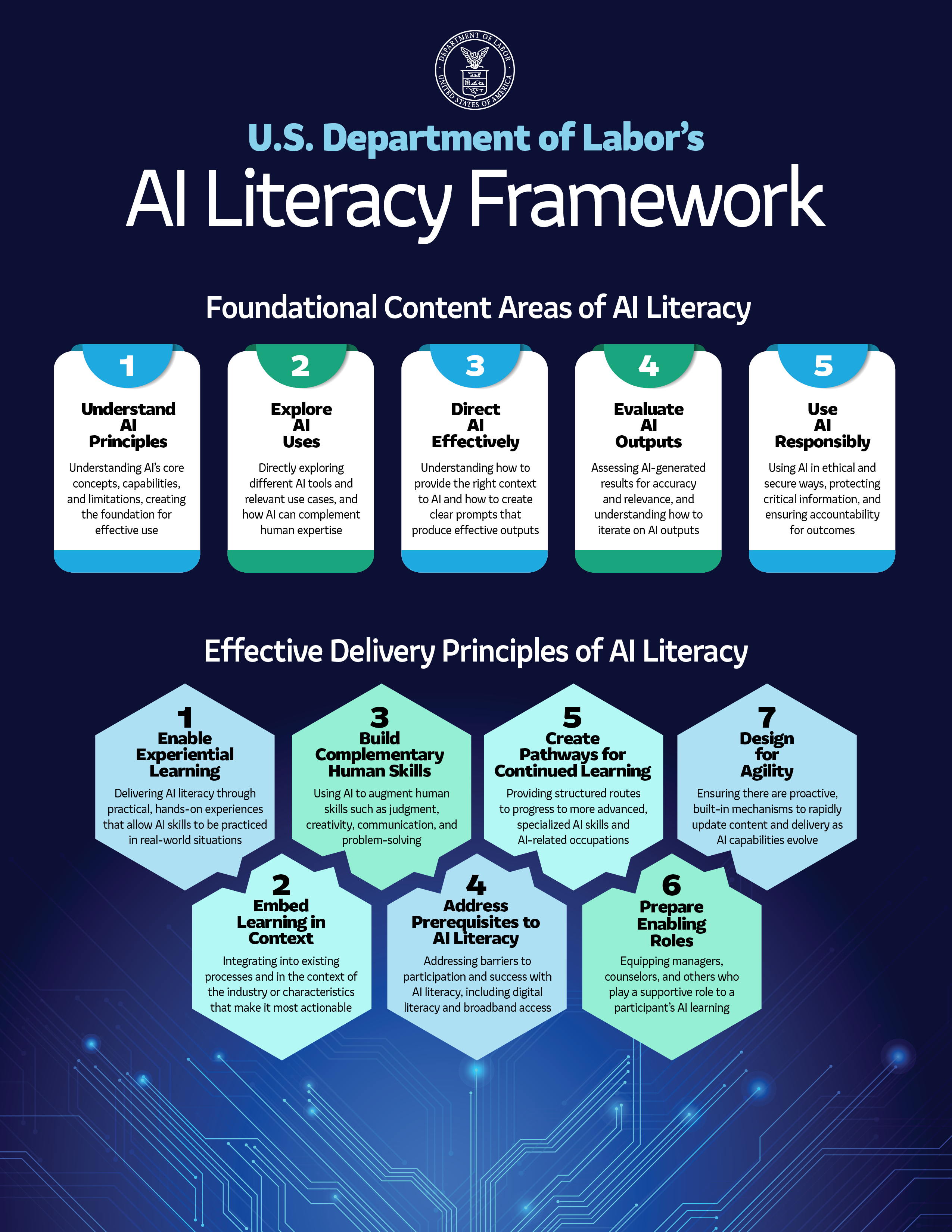
The US Department of Labor’s Employment and Training Administration published a framework for Artificial Intelligence literacy, providing a foundation to guide nationwide AI literacy efforts across workforce and education systems. The framework, which outlines five foundational content areas and seven delivery principles for AI literacy, is intended to be a resource to guide program design and deployment of AI literacy efforts, while allowing for flexibility and adaptation across industries, r

AI Doesn’t Reduce Work—It Intensifies It
Right now, many companies are worried about how to get more employees to use AI. After all, the promise of AI reducing the burden of some work—drafting routine documents, summarizing information, and debugging code—and allowing workers more time for high-value tasks is tantalizing. But are they ready for what might happen if they succeed? While leaders are focused on promised productivity gains, they may find themselves surprised by the complex reality, and may not see what these gains are costing them until it’s too late.
Inside the Cherokee Nation’s fiber program where graduates keep landing jobs
Whether it’s the price tag of a degree, or the uncertain prospects coming out of one, more job seekers are prioritizing stability.
Sens Warren, Wyden, Blumenthal Call on Federal Regulators to Investigate Meta, Google, NVIDIA “Reverse Acqui-hire” Deals
Senators Elizabeth Warren (D-MA), Ron Wyden (D-OR), and Richard Blumenthal (D-CT) urged the Federal Trade Commission (FTC) and the Department of Justice (DOJ) to enforce antitrust laws by investigating recent Big Tech “reverse acqui-hire” transactions, which, the senators warn, appear to be designed to evade antitrust scrutiny and risk further consolidating the Big Tech industry. In January 2026, FTC Chair Andrew Ferguson announced the agency would investigate Big Tech acquihires.
High-Speed Internet Boom Hits Low-Tech Snag: a Labor Shortage
Fiber cables were laid at a record-high number of homes in 2025, fueled by billions in federal grants for broadband internet. Tech companies’ voracious appetite for data centers is ratcheting up demand further, with the need for millions more miles of cables. Yet the rush to build is hitting a human bottleneck, particularly among workers who can piece together the fiber networks at the heart of the technology. Some jobs take months of training or an artist’s attention to detail; others require the physical strength and stamina to climb telephone poles in summer heat.

Who Lives in Rural America?
We’ve spent a lot of time and money in recent years to get better broadband for rural America, so I thought it would be of interest to look at who lives in rural America, based on data from the Federal Housing Finance Agency:

The Value of Broadband to a Community
A recent report, From Gig City to Quantum City: The Value of Fiber Optic Infrastructure in Hamilton County, TN 2011-2035, quantifies the benefit of the citywide municipal fiber network to the City of Chattanooga (TN). The fiber network is operated by EPB, the electric and fiber utility owned by the City of Chattanooga.
Blunt AI talk
Axios CEO Jim VandeHei wrote a note to his wife, Autumn, and their three kids. She suggested sharing it more broadly since so many families are wrestling with how to think and talk about AI. "You're living history. Ignoring it would be foolish and self-destructive," said VandeHei. "I want to urge you to plunge into understanding and using AI aggressively and daily, with a mindset of curiosity, awe, and clear-eyed discernment. You should download several LLMs: Gemini, ChatGPT, and Claude. They work similarly, intuitively and conversationally. Experiment with them.
Trump team touts a coming economic revolution as voters fear job losses
Facing a public worried that highly intelligent computers and a new generation of robots are coming for their jobs, the White House is embarking on a campaign to show that artificial intelligence (AI) will actually unleash an economic renaissance—and that President Donald Trump deserves a large dose of the credit. A report issued by the president’s economic advisers calls it the “Trump Revolution.” In the White House’s telling, America is pulling ahead in the race to dominate AI technology, priming the economy for rapid growth and helping the nation surpass China and Europe.
T-Mobile quietly conducts more layoffs
It appears that T-Mobile quietly conducted a series of layoffs just before the holidays, but it’s unknown exactly how many people were fired – or even when the trend might end. “Sales teams are being significantly reduced nationwide today.