

Gates Foundation: AI Could Help the Poorest Catch Up, or Leave Them Further Behind

Friday, September 18, 2026
Weekly Digest
Gates Foundation: AI Could Help the Poorest Catch Up, or Leave Them Further Behind
You’re reading the Benton Institute for Broadband & Society’s Weekly Digest, a recap of the biggest (or most overlooked) broadband stories of the week. The digest is delivered via e-mail each Friday.
Round-Up for the Week of September 14-18, 2026
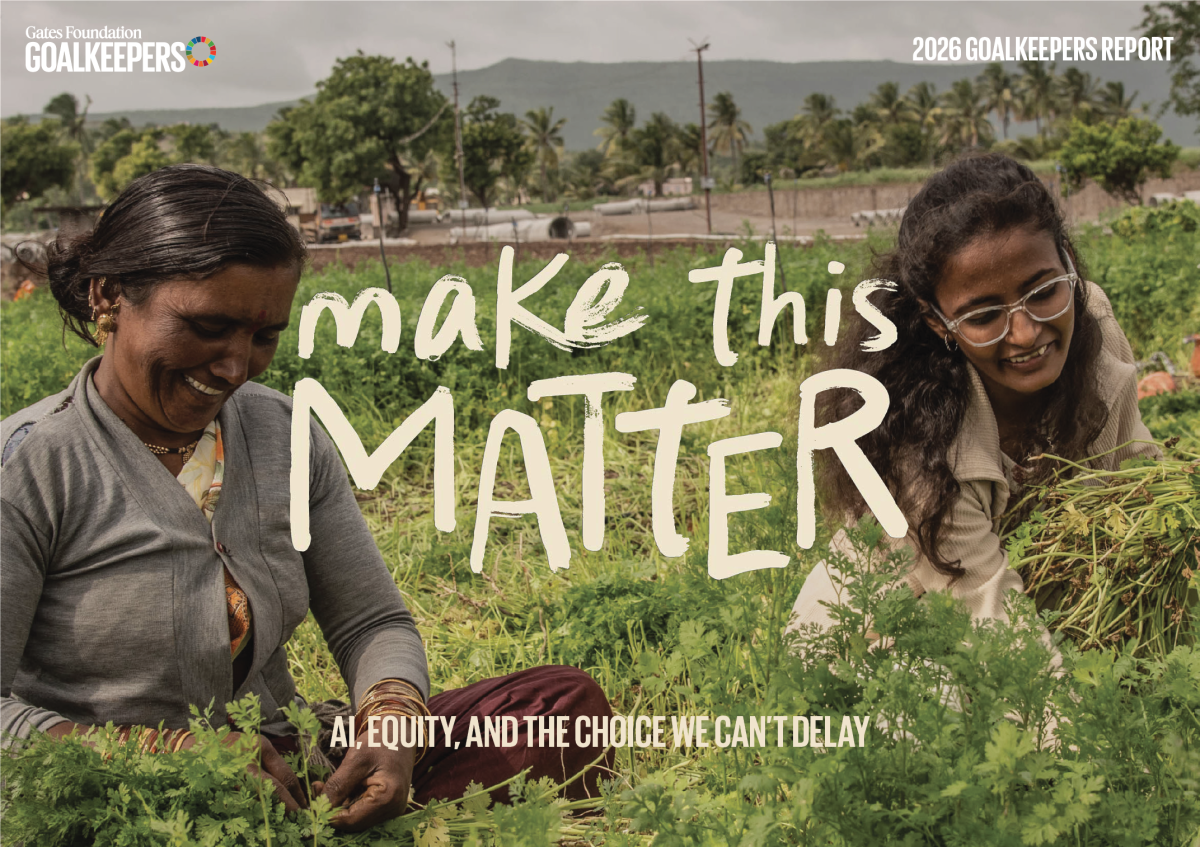
On September 15, the Gates Foundation released the 2026 Goalkeepers Report, Make This Matter: AI, Equity, and the Choice We Can't Delay. Goalkeepers tracks progress toward the Sustainable Development Goals (SDGs), which are 17 goals adopted by 193 world leaders in 2015. This year's report is the foundation's 10th, centering on what must happen now so that artificial intelligence (AI) shrinks, rather than grows, the distance between the world's richest and poorest people, and between wealthy and low-income countries. Foundation Chair Bill Gates frames the stakes, saying, "AI could be a great equalizer—or widen the gap. This is not a long-range prediction. It's a present-tense choice." The report is written in Gates's own voice; four frontline workers contribute guest essays.
The Problem
The report opens with progress. Worldwide, since 2000, child deaths have been cut in half, extreme poverty has declined, and deaths from HIV, tuberculosis, and malaria have fallen significantly. But new projections from the Institute for Health Metrics and Evaluation (IHME) at the University of Washington show that large gaps will persist on current trends:
- In 2045, a young adult in sub-Saharan Africa is projected to have three fewer years of schooling than a peer in a high-income country, 11 years versus 14.
- Nearly 900 million people will still live in extreme poverty, defined as living on less than $3 a day. Low-income countries will have 330 times as many people in extreme poverty as high-income countries.
- More than 3 million children will still die each year from diseases that are already preventable.
This progress is fragile. In some places, it has slowed, "made worse by devastating cuts to funding for global health in recent years."
The report identifies four challenges:
- Too few experts. In sub-Saharan Africa, one doctor serves roughly 2,000 people. In high-income countries, one doctor serves fewer than 200. Matching the high-income ratio would take more than two million additional doctors in sub-Saharan Africa. In some places, a single teacher manages 60 or more students, often across several grade levels. Many smallholder farmers have "simply no one to call for advice."
- Market failure. Gates writes that "the market is an extraordinary engine of innovation, but a terrible guarantor of equal opportunity." Left to the market, the most capable AI tools will be built first for the people and institutions most able to pay. Gates argues that AI's speed makes this familiar pattern unfold faster.
- A data and language gap. More than 90 percent of the data used to train early large language models came from English-language sources. Leading speech recognition systems make errors less than 6 percent of the time in English but fail more than 60 percent of the time in Yoruba, a major West African language. The report says AI improves monthly for about one billion mostly English-speaking people and stays the same for the other seven billion.
- A short window. Gates believes decisions made "in the next 12 to 18 months" about how AI is built, funded, and deployed will determine who benefits.
What the Gates Foundation Will Do
The report itself says only that the Gates Foundation "is ready to do our part" and is "already working with others." The foundation revealed its plans in an accompanying announcement. The foundation plans to spend at least $1 billion over two years to widen access to AI as well as to the solutions, opportunities, and knowledge AI can deliver. The money will help existing partners scale their work, split approximately as follows:
- 40 percent for education, including AI tutoring and teaching tools for classrooms in the United States and abroad,
- 40 percent for health care, ranging from diagnostics and decision support for frontline health workers to maternal and newborn care and drug and vaccine discovery,
- 10 percent for agriculture, including AI advice for smallholder farmers tailored to their soil, weather, and crops, and
- 10 percent for the "digital foundation" equitable AI requires, including datasets in languages current tools do not understand.
The report features four AI tools:
- Penda Health (Kenya): A clinical copilot built into patient visits improved diagnostic accuracy by 16 percentage points.
- Kiddom Atlas (United States): In early pilots across 21 middle schools, 7th graders gained the equivalent of six additional months of math learning in one school year.
- Gemini Guided Learning (Sierra Leone): In an eight-week trial across 12 schools, students made up to 1.7 years of typical learning progress.
- MahaVISTAAR (Maharashtra, India): This state-run advisory service has signed up more than 740,000 farmers, adds 70,000 new users each month, and costs the government less than 18 cents per farmer.
What Others Must Do
Gates says success requires "significant commitment from AI companies, governments, philanthropists, and many others." He specifically asks government leaders and AI developers to "measure success not only by what AI can do for the most profitable users but by what it can do for the people who stand the most to gain." The report names three "building blocks" to prioritize in the next 12 to 18 months:
- Work in every language. This requires investment in local-language datasets and evaluations that reflect how people actually speak, including dialects, accents, and slang.
- Ground AI in local data and local realities. Tools need local data, which the report says includes health records, farming outcomes, weather trends, and student learning patterns. Countries "should be able to decide on the best way to manage and protect that data," including storage and sharing terms. The report adds that "both closed and open AI systems have a role to play."
- Invest in people and access. The report calls for college programs, master's degrees, and hands-on training that build local AI expertise. The report also calls for access to AI models and "the ability to run them where they're needed." That access would come through price reductions, commitments from AI companies to share models and computing resources, and government and philanthropic funding.
The Gates Foundation also says AI must be affordable and must "earn people's trust by protecting their privacy and working in their specific contexts."
The foundation is already funding work on evaluation and local languages with partners. In February 2026, the Gates Foundation, the Novo Nordisk Foundation, and Wellcome announced a joint $60 million investment in the Evidence for AI in Health (EVAH) initiative, which supports locally led evaluations of AI health tools in low- and middle-income countries. EVAH aims to help governments and health systems learn which tools work, where they add value, and how to use them responsibly. At least 80 percent of EVAH funding must go to organizations based in eligible countries in sub-Saharan Africa, South Asia, or Southeast Asia.
On language, the Gates Foundation and donors from Germany, the United Kingdom, and Canada pledged $10 million in February 2025 to support African-led efforts to make AI models more inclusive of African languages. In May 2026, the foundation joined the Kenya-based Masakhane African Languages Hub, Microsoft's AI for Good Lab, and Google.org to launch LINGUA Africa, a call for proposals that funds African-language AI projects in data creation, model development, and real-world applications. Selected projects receive cash and cloud computing credits.
The Goal
The report sets a target: "Within three years, if we make the right choices, the most promising AI tools will be broadly deployed where they can make the biggest difference" in health, agriculture, and education. People in the most remote, lowest-resource settings should get the best possible guidance at the same time as people with the most resources. The report says the aim is not AI "designed somewhere far away and handed to communities to figure out," but communities with the knowledge and agency to shape how AI works for them.
What the Report Leaves Out: The Connectivity Gap
In one of the report's guest essays, Momodu Orgber Bah, a math teacher in Lungi Town, Sierra Leone, credits an AI tutoring tool with raising his class pass rate. He also names a limit: "a lot of my students don't have internet access at home, so they couldn't continue studying even if they wanted to." Bah encourages students who want extra practice to borrow their parents' phones.
Bah's observation is the report's only direct mention of the connectivity gap. The report's vision assumes connectivity with AI reaching people "through natural conversation, on a device already in their pocket" and working "on ordinary phones." When the report calls for investment in 'access,' it describes access to AI models and computing resources. It does not mention networks.
The gap is large. The International Telecommunication Union (ITU), the United Nations agency for digital technologies, estimates that 6 billion people used the internet in 2025 while 2.2 billion remained offline. Internet use closely tracks national income: 94 percent of people in high-income countries use the internet, compared with 23 percent in low-income countries. ITU also found that mobile broadband remains unaffordable in about 60 percent of low- and middle-income countries. The gap also exists in the United States, though U.S. figures come from a different survey and are not directly comparable to ITU's. The National Telecommunications and Information Administration found that 83 percent of people ages 3 and older used the internet in 2023; by subtraction, about 17 percent, or roughly one in six, did not.
The connectivity gap matters for the report's own argument. Gates warns that AI grows more capable for people already using it "while standing still for everyone else." People who are offline may still benefit indirectly when a connected health worker, teacher, or farm advisor uses AI on their behalf, as the report's examples describe. But people who are not online cannot use AI tools themselves, no matter how well those tools handle local languages or local conditions. The report's call for local data and local AI expertise also depends on connectivity: communities will struggle to contribute data, test tools, or build skills without reliable, affordable service. ITU's report likewise stresses that digital infrastructure, affordable service, and skills training are needed for everyone to benefit from technologies like AI. The foundation says 10 percent of its new $1 billion commitment will go to the "digital foundation" for equitable AI, with language datasets as one example. The foundation does not say whether any of that money will support connectivity. If everyone is to have the chance to both contribute to and benefit from AI, part of the plan must be to close the connectivity gap.
Quick Bits
- 50 U.S. States Broadband Speed Performance
- U.S. Broadband Industry Investment Reaches $92.6 Billion
- Proposed Fourth Quarter 2026 Universal Service Fund Contribution Factor
- Dario Amodei, Sam Altman and Elon Musk unite to warn the technology is advancing too fast
- Judge Orders Data Sharing and Other Fixes to Solve Google’s Ad Tech Monopoly
Weekend Reads
- Federal broadband investment and rural business formation: Evidence from rejected applicants
- Democrats are now more worried than Republicans about AI and its impact on jobs
- Two Views of the Same Transformation: AI Adoption, Invisible Work, and the Human Side of Organizational Change
- Americans Value Press Freedom but Differ on Its Limits
ICYMI from Benton
- A Call for a New Communications Act
- Broadband Heresies: Or, what Twilight, Harry Potter, X-Men, and The Incredibles can teach us about telecommunications policy
- How Public is the Public Cloud?
- Public Municipal Data Centers
- Pairing Harms and Remedies in the Meta Settlement
Upcoming Events
Sept 22—AI, Speech, and the First Amendment: Where Are the Constitutional Lines? (Congressional Internet Caucus)
Sept 22—The Class of '96: Legacy of the Fight to Close the Digital Divide (Public Knowledge)
Sept 23—The Next Digital Infrastructure Race: Hyperscalers, AI, and the Future of Connectivity (Georgetown University)
Sept 24—25 Hours. One Connected World. (Connected Nation)
Sept 24—Augmented and Virtual Reality Policy Conference (ITIF)
Sept 24—A New Compact for Connectivity: Internet Infrastructure in the Public Interest (Benton Institute for Broadband & Society)
Sept 25-26—TPRC54
Sept 30—September 2026 Open Federal Communications Commission Meeting
Oct 7-9—AnchorNets 2026 (SHLB Coalition)
Oct 8—23rd Annual IP3 Awards (Public Knowledge
The Benton Institute for Broadband & Society is a non-profit organization dedicated to ensuring that all people in the U.S. have access to competitive, High-Performance Broadband regardless of where they live or who they are. We believe communication policy - rooted in the values of access, equity, and diversity - has the power to deliver new opportunities and strengthen communities.
© Benton Institute for Broadband & Society 2026. Redistribution of this email publication - both internally and externally - is encouraged if it includes this copyright statement.
For subscribe/unsubscribe info, please email headlinesATbentonDOTorg

Kevin Taglang
Executive Editor, Communications-related Headlines
Benton Institute
for Broadband & Society
1041 Ridge Rd, Unit 214
Wilmette, IL 60091
847-220-4531
headlines AT benton DOT org
Share this edition:


Broadband Delivers Opportunities and Strengthens Communities