

Public Municipal Data Centers

Tuesday, September 15, 2026
Digital Beat
Public Municipal Data Centers

Join the conversation! On September 24th, Preston Rhea will present a lightning talk about municipal data centers and the public ownership of compute. The Benton Institute for Broadband & Society will bring together leaders from industry, government, academia, and the public-interest community for A New Compact for Connectivity: Internet Infrastructure in the Public Interest. You can join us online or in-person in Washington, D.C.
We are facing the multi-trillion-dollar march of private artificial intelligence (AI) data centers into our economy, politics, ecosystem, and cultural life. Amid calls for blanket moratoria and investments in data centers in space, how can the public assert a controlling interest in the development and outcomes of this technology?
This essay proposes developing municipally owned, small-scale data center capacity to support municipal services and public-interest AI. To encourage outcomes in the public interest, infrastructure investments must shift away from primarily private, hyperscale facilities (massive data centers designed to efficiently support thousands of servers and scale computing power up or down on demand) and toward publicly accountable, resource-aware, incremental, and flexible deployments.
The Need for Public Investment
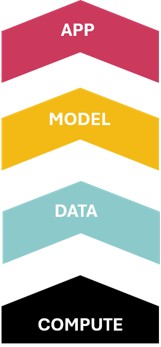
AI is built on a technology stack of physical infrastructure, data, models, and applications.[1] “Compute,” the physical layer of this stack, is the processing power that computers use to perform tasks or run programs, enabling the “cycles” AI applications need. Compute comprises three components: chips, software, and data centers to house the hardware.[2] Currently, ownership of these components and layers is overwhelmingly private. By one estimate, the public sector’s share of AI “supercomputer” performance—a proxy for ownership of actually deployed capacity—dropped from about 60% in 2019 to less than 20% as of 2025, while the private sector’s share rose to more than 80% of supercompute performance.[3] That estimate reflects ownership trends for the “core component of the AI supply chain”: the largest and most powerful AI data centers. In a time of corporate privatization of this foundational part of AI, public ownership of the fundamental productive asset is critical to achieve durable public goods.[4]
The AI Stack
Source: HR&A Advisors, Inc., adapted from Bertelsmann Stiftung
Municipalities have already seen outcomes of private concentration over data center ownership. The circular AI economy—the concentrated loop of investments between a few entities that underpins the current data center boom[5]—is dominated by the hyperscalers and private investors that set the terms for access to and cost of these tools, while encouraging or forcing communities to accept the externalities: higher electricity rates, pollution from gas turbines, omnipresent noise, and eroding transparency and support for elected officials involved in siting.[6] On the current trajectory, local government’s only relationship with compute may soon be to receive an invoice from consolidated owners.
This is not a new idea. Public investment in compute capacity has been a feature of public policy for nearly a century. Wartime government investment in the USA’s Electronic Numerical Integrator and Computer (ENIAC) and the UK’s Colossus spurred further military and intelligence applications, leading to the creation of the civilian mainframe market.[7] “Time sharing” on university mainframes for research, co-developed with the Defense Department investments, nurtured Silicon Valley’s industrial movement to push computers into every aspect of our lives. Public investment was the initial spark for compute to emerge as infrastructure that can enable public-interest research and service improvements.[8]
Today, several marquee public compute efforts exist at the national level, but none are both publicly owned and made available as a priority for municipal service delivery. National public compute clusters like the European Union’s AI Factories,[9] the United States’ National AI Research Resource (NAIRR),[10] and efforts in countries like Singapore,[11] the UK,[12] Switzerland,[13] and France[14] provide compute as a policy instrument for investment, national defense, frontier[15] model development, academic research, and some capacity for select startups in their jurisdictions, but not for municipal purposes. The US also has some sub-national public compute, most notably the State of New York’s Empire AI.[16]
The U.S. also has some small-scale public AI interventions, like Public AI Network’s kiosks in a handful of libraries.[17] But the program uses private-sector compute, and these kiosks do not provide municipal services.
A critical municipal-level gap in capacity is emerging for many of the goals cited by the leading advocates for public AI. Yet, the elements for its construction are ready to be organized—and crucially, to benefit from smaller horizons.
“Right-Sized” Compute at the Municipal Level
Local government can learn from the municipal broadband movement and take some control of the AI ecosystem from over-consolidated hyperscalers, making public municipal data centers a foundation for public goods and pro-social development outcomes. “Right-sized” builds may be one to three racks or just a node in a rack the size of a cabinet; drawing as much power as a large rooftop heating, ventilation, and air conditioning (HVAC) unit; and sited inside a small part of a reconfigured municipal office. A minor commitment of that size can enable public institutions to middle-scale AI for municipal services while providing a public AI option—bigger than a desktop or phone, smaller than a campus.
Acquiring municipal-scale compute looks familiar to IT budget line items. The difference is the service and mission-economy orientation. A rack with only one node for AI inference could be acquired in the low hundreds of thousands of dollars,[18] or less with earlier-generation chips or chips suited for everyday applications.[19] That partially deployed rack could serve the needs of a mid-size city's departmental tasks like permitting applications, records search, and chat applications; it could even serve several small municipalities as a shared resource. One company runs this service for nearly one hundred municipalities using only hardware owned by the company rather than rented cloud capacity.[20] Ongoing equipment costs include electricity, cooling, and hardware maintenance; one vendor estimates a node draws about $7,500 per year in electricity, but local utility rates would shift this[21].
Chips have a shorter life cycle than fiber—perhaps five years for chips, with that window shortening as next-generation compute renders previous generations of chips obsolete,[22] while fiber can last 20 years or more.[23] Running the AI inference could be done with existing staff as a fractional job for departments that already procure and manage on-premises servers, with potential follow-on investment in expertise for model updates, access management, and model tuning. The market for that labor is tightening amid the current boom.[24] Yet chips are not the real value. Instead, the value is the municipality's improved management capability over the asset and service.
What Renting Cannot Buy
Municipalities have options to procure right-sized compute infrastructure. Renting compute is much cheaper at market rates for the volume of inference (the computing done each time a trained model answers a query, distinct from the computing used to build the model) a locality needs than standing up the same amount in a small data center. But municipalities play a trusted role in our economy. Responsibilities like analyzing vulnerable residents' case files demand higher standards, especially when using AI for public purposes.
Municipalities will need enhanced safeguards for mission-critical functions. These four conditions may guide when a municipality would want to provide its own compute capacity:
- Data protection, to keep sensitive resident and municipal data inside a governed environment,
- Algorithmic accountability, to keep in-environment processes that support judgment on decisions,
- Capacity reservation across departments in case of scarce resources and price spikes, and
- Operational resilience in case third-party solutions and connectivity fail.
The current model for municipalities to access compute is largely baked into Software as a Service (SaaS) contracts: the pricing of "seats" on enterprise AI services bundles the price of inference. This dependency leaves local government and public policy to subsidize the hyperscaler model, with little control over the cost and availability of compute or the power needed to mitigate the environmental externalities and electricity-rate costs of data centers.[25]
As “open weight” models (AI systems whose internal settings are publicly downloadable) become more prevalent, municipalities may want to download these models to their own servers and run inference on them. Frontier-AI training costs have increased roughly 3.5 times annually since 2020,[26] while data-center capacity follows the same private concentration curve.[27] Inference is still accessible at municipal scale, but the same data center firms will continue to consolidate. With the current hunger for expanding compute, municipalities have an opportunity to control their own fate at a scale accessible to capable IT departments before going down the path that led to the cable-telco duopoly in much of this country. While wireline competition has improved in recent years, the Federal Communications Commission’s 2024 Communications Marketplace Report found that the largest broadband market category offered a choice between two fixed terrestrial broadband providers, covering about 37% of households.[28] To avoid repeating this path in the AI era, municipalities can build small-scale compute networked in a municipal cloud to open public territory for AI applications and services.
What Municipalities Can Do Now
Some municipalities already have one or more resources for a pilot public compute effort. Take EPB of Chattanooga (formerly known as the Electric Power Board of Chattanooga), whose marquee power and fiber utility is now enabling a new kind of investment—the EPB Quantum Center, building on the EPB Quantum Network the utility launched in 2022 on its existing fiber-optic backbone.[29] EPB stood up this pioneering effort through its $22 million partnership with IonQ, announced in 2025, redeploying its existing real estate, fiber, and power capacity along with its expertise in managing these assets.[30] Without conflating quantum networks and AI, Chattanooga’s example shows the assets municipalities can use to build their first small data centers, including:
- Real estate, even part of the floor of a building,
- Power generation, transmission, and utility ownership,
- Water systems, for cooling and heat removal,
- Fiber and conduit, especially where dig-once policies bundle it with power and water work, plus right-of-way control for cost-effective multi-use of pathway,
- IT departments with civic-entrepreneurial leadership,
- Favorable climates that reduce cooling needs or let data centers offset heating costs,[31]
- Local communities of practice including industry, startup ecosystems, and educational institutions, and
- Unique data combined with a drive to simplify a longstanding practice or problem, like permitting.
Municipalities can develop this capacity without replicating the speculative overbuilding dynamics that characterize hyperscaler data center expansion. Using assets already at hand lets municipalities absorb less downside risk if that investment cycle corrects while shaping what public compute is for: public interest service delivery, market accountability, and building the institutional competence municipalities need to govern the next generation of AI-enabled public services.[32]
Learning From Municipal Broadband
Many skills and processes behind the movement to build municipal fiber networks apply to integrating data centers into municipalities’ mission economy toolkit. More than 400 municipal broadband networks serve over 700 communities in the US, despite decades of industry-backed efforts through entities like the American Legislative Exchange Council (ALEC) to pass state laws halting them.[33] Lessons from that movement can help the public interest get ahead of consolidators’ grip on the AI future.
The municipal broadband movement shows the potential of services over public infrastructure, along with cautionary lessons. The public sector can be a great infrastructure holder of first resort, but large buildouts carry inherent risk. The hard-learned failures include Burlington, Vermont's experience—which included shifting $16.9 million from its general fund to support its municipal network, being sued by Citibank, and executing a sale-leaseback before finally selling the network in 2019[34]—and Lake County, Minnesota, which received $66 million in federal financing to build its Lake Connections network and sold it in 2019 for $8.4 million while still owing $48.5 million to the federal government.[35] Municipal-scale networks require large capital and infrastructure commitments, with a drive towards universal service and commensurate operating expenses stretched over territory, field technician teams, and truck rolls for installation and repair, and the demonstrated threat of state-level restriction and litigation for providing telecommunications and/or video service[36].
But the foreseeable needs of municipal compute do not match municipal networks' requirement of wide scale to sustain operations that justify their high capital expense. By definition, a municipal compute pilot can start small and scale as needed, with no presumption of the need for bonds or consumer service-level agreements. And while this question is not yet legally tested, municipal broadband restrictions in some states are not likely to cover AI compute for internal departmental purposes, though the particulars vary by state. Municipal compute provision is a lower-stakes test than a broadband network. If it fails, the outcome will not be a bond default but a return to cloud contracts.
Driving Towards Desired Outcomes
Investments in public compute should be part of a larger mission-oriented industrial strategy.[37] Municipalities will need to cultivate expertise and operational practices to advance service provision and the well-being of residents and workers. Strategic goals should include:
- Maintain and expand a municipality’s capacity to innovate and deliver modern services, across current and future AI capabilities, including by opening public-sector career pathways for AI-savvy talent that otherwise flows to private employers and feeds talent pipelines for regional labs and educational institutions,
- Resilience and continuity of operations. By owning a fundamental part of production, municipalities can hedge against contracting for compute. In-house capacity also strengthens leverage to set procurement standards for energy efficiency, local hiring, and data governance across the vendor ecosystem,
- Provide community access to compute, models, and applications at favorable terms for municipalities’ policy goals, and as test beds that lower startup costs and research barriers for local AI ecosystems without ceding control to a single private operator,
- Align with other mission-oriented infrastructure initiatives like generating load for public utilities,[38] making use of real estate, and expanding conduit and fiber to connect nearby residents to the internet,[39] and
- Anchor adaptive reuse of industrial space with siting decisions for small compute facilities, including coordinated fiber buildout in underserved corridors.
Building and serving compute via small, decentralized data centers is within reach for governments that can leverage what they already have and know how to use it. Municipalities should start small[40] with their compute footprint and grow as needed rather than matching the scale of the hyperscalers.[41] In 1999, Google’s first data center was 28 square feet of space and about 30 commodity PCs.[42] An AI startup in San Diego owns its own small data center, which it priced at $5 million, because it saves money long-term compared to compute contracts.[43] Even smartphones run AI inference on the device today.[44]
Start with a modest pilot in one repurposed or multi-use facility, like one rack in part of an office room. Then scale based on measured demand, operating experience, and grid constraints. Despite headline costs for compute, data center investment, and foundation model training,[45] municipal AI use cases have so far centered on narrow, document-oriented tasks—grant discovery, benefits eligibility checks, records search—rather than on building models[46]. Work of that kind runs on existing models, adapted through fine-tuning and post-training (adjusting a model with targeted edits) or served directly as inference, at a small fraction of the compute required to train a frontier model from scratch.[47]
Municipal intervention is an intelligent hedge against current market behavior. Market signals alone cannot plan for scenarios far in the future. Industries need a public alternative, educational institutions need an advantaged sandbox to attract researchers, and forward-thinking IT experts and policymakers want to put their skills toward the public good, not just profit.
A Foundation For Long-Term Outcomes
Municipalities that want to build their own data centers should identify the assets and tools they have, and what help they will need to fill the gaps. AI services that governments already use, like Massachusetts’s GrantWell tool to help municipalities apply for state grants, Mississippi’s Document Coach to help check benefits eligibility before assigning caseworkers, and Colorado’s AI sandbox test ground,[48] could be adapted and run on a municipality’s own compute server. Then, that server could provide a platform for community uses at off-peak load. Just as EPB’s fiber to reduce streetlight outages supported gigabit broadband service in Chattanooga, surplus municipal compute capacity could lead to more equitable community access to AI.
These entrepreneurial municipalities should align with others standing up public compute. If multiple municipalities build their own small data centers, they can connect through fiber leases, enabling a new network of municipal compute. They can link with non-municipal entities like the Public AI Network’s library pilot program, which anticipates the networked public cloud that municipal compute could seed, rooted in access to local archives that could ultimately tune local models. A true general civic cloud would recall the internet’s beginnings, when the National Science Foundation Network (NSFNET) linked leased 56 kbps connections across the country to a few research hubs and evolved into the backbone of the network we use today.[49]
Starting small will open new horizons for municipalities’ capabilities to achieve their public service missions.[50] This is an opportunity for municipalities to provide a next-generation category of services, take risks, and build competency and control over the emerging productive assets of the 21st century.
Preston Rhea is a Principal in the Technology & Society Studio at HR&A Advisors, where he advises cities, counties, and states on broadband and public technology infrastructure. This paper reflects his own views and is not a position of HR&A. Contact: prhea@hraadvisors.com
Notes
[1] Felix Sieker et al., Public AI White Paper – A Public Alternative to Private AI Dominance, ed. Bertelsmann Stiftung (Bertelsmann Stiftung, May 20, 2025), https://www.bertelsmann-stiftung.de/en/publications/publication/did/public-ai-white-paper-a-public-alternative-to-private-ai-dominance.
[2] Luiz André Barroso, Urs Hölzle, and Parthasarathy Ranganathan, The Data Center as a Computer: Designing Warehouse-Scale Machines, 4th ed., Synthesis Lectures on Computer Architecture (Cham: Springer, 2026), https://doi.org/10.1007/978-3-031-99489-0.
[3] Konstantin F. Pilz, James Sanders, Robi Rahman, and Lennart Heim, "Trends in AI Supercomputers," arXiv, April 23, 2025, https://arxiv.org/html/2504.16026v2#Sx1.F3.
[4] Public AI Network, "Public AI: Infrastructure for the Common Good" (Public AI Network, Aug. 10, 2024), https://publicai.network/whitepaper; Mark Surman, Nik Marda, and Jasmine Sun, "Public AI: Making AI Work for Everyone, by Everyone" (Mozilla Foundation, Sept. 30, 2024), https://www.mozillafoundation.org/en/research/library/public-ai/; Ganesh Sitaraman and Karun Parek, "The Global Rise of Public AI" (Vanderbilt Policy Accelerator, May 8, 2025), https://law.vanderbilt.edu/vpa-releases-new-paper-on-the-global-rise-of-public-artificial-intelligence/; Ganesh Sitaraman and Alex Pascal, "The National Security Case for Public AI" (Vanderbilt Policy Accelerator, Sept. 29, 2024), https://cdn.vanderbilt.edu/vu-URL/wp-content/uploads/sites/412/2024/09/27201409/VPA-Paper-National-Security-Case-for-AI.pdf.
[5] Cedric Sam et al., "A Guide to the Circular Deals Underpinning the AI Boom," Bloomberg Technology, January 22, 2026, updated August 19, 2026, https://www.bloomberg.com/graphics/2026-ai-circular-deals/; Rahil Solanki, "The AI Circular Economy: Systemic Risk, Vendor Financing, and the Keystone Problem" (April 28, 2026), SSRN, https://papers.ssrn.com/sol3/papers.cfm?abstract_id=6672478.
[6] Monitoring Analytics, LLC, 2026 Quarterly State of the Market Report for PJM: January through March, Section 1 (Eagleville, PA: Monitoring Analytics, LLC, May 14, 2026), https://www.monitoringanalytics.com/reports/PJM_State_of_the_Market/2026/2026q1-som-pjm-sec1.pdf; Neha Gour, Ed Maibach, and Luis Ortiz, "5 Ways Data Centers Endanger Their Local Communities and the Country as a Whole," The Conversation, June 8, 2026, https://theconversation.com/5-ways-data-centers-endanger-their-local-communities-and-the-country-as-a-whole-282348; Jasmine Laws, "Data Centers Spark Dozens of Recall Petitions Against Local Officials," Newsweek, July 8, 2026 (updated July 10, 2026), https://www.newsweek.com/data-centers-spark-dozens-of-recall-petitions-against-local-officials-12170541.
[7] Robert W. Leland, “Historical Impact of Government Investment in High Performance Computing,” presentation, IEEE International Conference on Rebooting Computing, San Diego, October 17, 2016, Sandia National Laboratories SAND2016-10552C, https://www.osti.gov/servlets/purl/1404817.
[8] Matt Davies and Jai Vipra, "Computing Commons: Designing Public Compute for People and Society" (Ada Lovelace Institute, Feb. 7, 2025), https://www.adalovelaceinstitute.org/report/computing-commons/; Sarosh Nagar and David Eaves, "Building Public Compute for the Age of AI" (Lawfare, Aug. 7, 2025), https://www.lawfaremedia.org/article/building-public-compute-for-the-age-of-ai.
[9] Nicole Lemke and Catherine Schneider, "The European Union's AI Factories" (interface, Oct. 30, 2025), https://www.interface-eu.org/publications/ai-factories; European Commission, "EU Launches InvestAI Initiative to Mobilise €200 Billion of Investment in Artificial Intelligence," press release IP/25/467, Feb. 11, 2025, https://ec.europa.eu/commission/presscorner/detail/en/ip_25_467.
[10] "Public AI Seminar – Nicole DeCario and Katie Antypas," video, Aug. 20, 2024, Internet Archive, https://archive.org/details/public-ai-decario-antypas; U.S. National Science Foundation, "NAIRR at 2 Years," March 19, 2026, https://www.nsf.gov/cise/updates/nairr-2-years-advancing-american-artificial-intelligence; Yale Center for Research Computing, "National Artificial Intelligence Research Resource (NAIRR)," last modified Feb. 5, 2026, https://docs.ycrc.yale.edu/ai/nairr/.
[11] National Supercomputing Centre Singapore, “ASPIRE 2B,” NSCC, accessed August 7, 2026, https://www.nscc.sg/aspire-2b/.
[12] Department for Science, Innovation and Technology, “AIRR Compute Opportunity: AI for Science,” notice, GOV.UK, November 21, 2025, https://www.gov.uk/government/publications/airr-compute-opportunity-ai-for-science.
[13] ETH Zurich, “Apertus: A Fully Open, Transparent, Multilingual Language Model,” press release, September 2, 2025, https://ethz.ch/en/news-and-events/eth-news/news/2025/09/press-release-apertus-a-fully-open-transparent-multilingual-language-model.html.
[14] “NVIDIA and GENCI Expand Access to AI Compute Through AI Factory France,” HPCwire, June 18, 2026, https://www.hpcwire.com/off-the-wire/nvidia-and-genci-expand-access-to-ai-compute-through-ai-factory-france/.
[15] Markus Anderljung et al., "Frontier AI Regulation: Managing Emerging Risks to Public Safety," arXiv, July 6, 2023 (revised November 7, 2023), https://arxiv.org/abs/2307.03718; United Nations Secretary-General's Scientific Advisory Board, "Verification of Frontier AI Models," science brief, June 13, 2025, https://www.un.org/scientific-advisory-board/en/verification-frontier-ai-models.
[16] HR&A Advisors and Friends of Empire AI, “Empire AI Impact Analysis,” December 12, 2025, https://www.empireai.edu/2025/12/12/new-independent-analysis-finds-empire-ai-poised-to-deliver-billions-in-economic-and-societal-benefits-for-new-yorkers/.
[17] Public AI Network, Metagov, and Public Knowledge, “Building Public AI with Libraries,” national pilot program, 2025–2026, accessed August 7, 2026, https://libraries.publicai.co/.
[18] Mercatus Compute. "NVIDIA H100 Server Price in 2026: What an 8-GPU HGX System Costs." Mercatus (blog). Last modified July 14, 2026. https://www.mercatus-ai.com/blog/h100-server-price.
[19] Protasov, Konstantin. "Used GPU Server Buying Guide 2026: L40S vs A100 vs RTX 4090." PCSP News (blog). July 8, 2026. https://pcserverandparts.com/news/used-gpu-server-buying-guide-2026-l40s-vs-a100-vs-rtx-4090/.
[20] NVIDIA. "Onetera Uses NVIDIA AI to Transform Municipal Services." NVIDIA Customer Stories. Published September 1, 2026. https://www.nvidia.com/en-us/case-studies/ai-powered-smarter-municipal-operations/.
[21] Haink. "AI Infrastructure Cost Guide 2026 — GPU Cluster Costs, ROI, and Total Cost of Ownership." Haink Knowledge Hub. Accessed September 9, 2026. https://haink.org/knowledge/technology/ai-infrastructure-cost-guide.
[22] Usvyatsky, Olga. "Amazon Revises Server Lifespan amid AI Shift, Impacting 2025 Earnings." Deep Quarry (Substack). February 11, 2025. https://deepquarry.substack.com/p/amazon-revises-server-lifespan-amid.
[23] Fiber Broadband Association, Technology Committee. Fiber Broadband Scalability and Longevity. Fiber Broadband Association, February 2024. https://fiberbroadband.org/wp-content/uploads/2024/02/FBA-0018E_ScalabilityLongevity_WhitePaper_lv2.pdf.
[24] Uptime Institute. "Uptime Institute 16th Annual 2026 Global Data Center Survey: Deployment of High Density Racks Rising Fast, Operators Face Continued Recruiting and Retention Pressures." Press release, July 28, 2026. https://uptimeinstitute.com/about-ui/press-releases/16th-annual-2026-global-data-center-survey-deployment-of-high-density-racks-rising-fast-operators-face-continued-recruiting-and-retention-pressures.
[25] WilmerHale, "Data Centers in Court: The Emerging Wave of Nuisance, Environmental, and Land-Use Litigation," client alert, July 13, 2026, https://www.wilmerhale.com/en/insights/client-alerts/20260713-data-centers-in-court-the-emerging-wave-of-nuisance-environmental-and-land-use-litigation; Monitoring Analytics, LLC, 2026 Quarterly State of the Market Report for PJM: January through March, Section 1 (Eagleville, PA: Monitoring Analytics, LLC, May 14, 2026), https://www.monitoringanalytics.com/reports/PJM_State_of_the_Market/2026/2026q1-som-pjm-sec1.pdf.
[26] Epoch AI, "Trends in Artificial Intelligence," last modified Feb. 5, 2026, https://epoch.ai/trends; Epoch AI, "Data on AI Models," accessed Aug. 7, 2026, https://epoch.ai/data/ai-models.
[27] Epoch AI, “Data on AI Data Centers,” Epoch AI, accessed August 7, 2026, https://epoch.ai/data/ai-data-centers.
[28] Federal Communications Commission, 2024 Communications Marketplace Report, FCC 24-136, GN Docket No. 24-119 (Washington, DC: FCC, adopted December 30, 2024, released December 31, 2024), https://docs.fcc.gov/public/attachments/FCC-24-136A1.pdf.
[29] Bento J. Lobo, "From Gig City to Quantum City," CRER White Paper No. 13 (Chattanooga, TN: University of Tennessee at Chattanooga, Center for Regional Economic Research, March 2026), https://www.utc.edu/sites/default/files/2026-03/crer-white-paper-13-quantum.pdf.
[30] Charlotte Trueman, "IonQ Partners with EPB of Chattanooga for $22m Quantum Computing Center in Tennessee," Data Center Dynamics, May 6, 2025, https://www.datacenterdynamics.com/en/news/ionq-partners-with-epb-of-chattanooga-for-22m-quantum-computing-center-in-tennessee/.
[31] Thea de Gallier, “4 Innovative Ways to Harness Waste Data Centre Energy,” World Economic Forum, February 13, 2024, https://www.weforum.org/stories/energy-transition/harnessing-waste-energy-data-centres/. See also Barroso (2026).
[32] Eleanor Shearer, Matt Davies, and Mathew Lawrence, “The Role of Public Compute,” Ada Lovelace Institute, April 24, 2024, https://www.adalovelaceinstitute.org/blog/the-role-of-public-compute/.
[33] Sean Gonsalves, "New Map Displays Nationwide Trends in Municipal Networks," ILSR, Sept. 12, 2024, https://ilsr.org/article/community-broadband-networks/new-map-displays-nationwide-trends-in-municipal-networks/; current data at ILSR Community Networks Map, last modified March 23, 2026, https://apps.communitynets.org/ilsr-broadband-map/; Jon Brodkin, "FCC Consumer Advisory Panel Includes ALEC," Ars Technica, April 12, 2019, https://arstechnica.com/tech-policy/2019/04/fcc-consumer-advisory-panel-includes-alec-big-foe-of-municipal-broadband/; Yvonne Wingett Sanchez and Rob O'Dell, "What Is ALEC?," Center for Public Integrity, April 4, 2019, https://publicintegrity.org/politics/state-politics/copy-paste-legislate/what-is-alec-the-most-effective-organization-for-conservatives-says-newt-gingrich/.
[34] Jacob Dawson, "Vermont Supreme Court Upholds Burlington Telecom Sale," VTDigger, January 17, 2020, https://vtdigger.org/2020/01/17/vermont-supreme-court-upholds-burlington-telecom-sale/; Timothy McQuiston, "Citibank Fully Releases Burlington from $33.5 Million BT Lawsuit," Vermont Business Magazine, March 13, 2019, https://vermontbiz.com/news/2019/march/13/citibank-fully-releases-burlington-335-million-bt-lawsuit.
[35] Ann Treacy, "Lake County Accepts $8.4M Bid for Lake Connections from Pinpoint Holdings," Blandin on Broadband, December 23, 2018, https://blandinonbroadband.org/2018/12/23/lake-county-accepts-8-4m-bid-for-lake-connections-from-pinpoint-holdings/; Kitty Mayo, "Lake County Broadband Sold," BusinessNorth, June 26, 2019, https://www.businessnorth.com/daily_briefing/lake-county-broadband-sold/article_2dc74eb2-9836-11e9-914a-1f2fc2a242e3.html.
[36] Tyler Cooper, "Municipal Broadband Remains Roadblocked in 16 States," BroadbandNow, May 14, 2024, https://broadbandnow.com/report/municipal-broadband-roadblocks; Sean Gonsalves, "The State of State Preemption: Stalled – But Moving In More Competitive Direction," Community Networks (Institute for Local Self-Reliance), November 1, 2024, https://communitynetworks.org/content/state-state-preemption-stalled-moving-more-competitive-direction.
[37] Mariana Mazzucato, Sarah Doyle, and Luca Kuehn von Burgsdorff, Mission-Oriented Industrial Strategy: Global Insights, IIPP Policy Report No. 2024/09 (London: UCL Institute for Innovation and Public Purpose, July 2024), https://www.ucl.ac.uk/bartlett/publications/2024/jul/mission-oriented-industrial-strategy-global-insights.
[38] Robin Gaster, The United States Needs Data Centers, and Data Centers Need Energy, but That Is Not Necessarily a Problem (Washington, DC: Information Technology and Innovation Foundation, November 24, 2025), https://www2.itif.org/2025-data-centers-energy.pdf.
[39] Mahsa Arabi et al., "Benefits of Aggressively Co-Undergrounding Electric and Broadband Lines Outweigh Costs," Cell Reports Sustainability 2, no. 3 (2025): 100334, https://doi.org/10.1016/j.crsus.2025.100334; Bill Coleman, Own Your Internet: How to Build a Public Broadband Network (AAPB/Benton Institute, March 6, 2024), https://www.benton.org/publications/public-broadband-handbook.
[40] Zack Quaintance, “Beyond Limits: Cities Large and Small Put AI to Use,” Government Technology, Fall 2025 issue, published online December 18, 2025, https://www.govtech.com/artificial-intelligence/beyond-limits-cities-large-and-small-put-ai-to-use.
[41] Stacy Mitchell and John Farrell, “The Policies Communities Need to Confront the AI Data Center Race,” Institute for Local Self-Reliance, May 19, 2026, https://ilsr.org/articles/the-policies-communities-need-to-meet-the-ai-moment/.
[42] Rich Miller, "Looking Back: Google's First Data Center," Data Center Knowledge, Feb. 5, 2014, https://www.datacenterknowledge.com/hyperscalers/looking-back-google-s-first-data-center; Urs Hölzle, "A Trip Down Memory Lane – Exactly 25 Years," LinkedIn, Sept. 28, 2023.
[43] Harald Schäfer, “Owning a $5M Data Center,” comma.ai blog, February 3, 2026, https://blog.comma.ai/datacenter/.
[44] Apple, “Introducing Apple Intelligence for iPhone, iPad, and Mac,” Apple Newsroom, June 10, 2024, https://www.apple.com/newsroom/2024/06/introducing-apple-intelligence-for-iphone-ipad-and-mac/.
[45] Jesse Noffsinger, Mark Patel, and Pankaj Sachdeva, “The Cost of Compute: A $7 Trillion Race to Scale Data Centers,” McKinsey Quarterly, April 28, 2025, https://www.mckinsey.com/industries/technology-media-and-telecommunications/our-insights/the-cost-of-compute-a-7-trillion-dollar-race-to-scale-data-centers.
[46] Center for Civic Futures, "Grant Discovery Platform for Public Funding Opportunities: Massachusetts," AI Knowledge Hub, 2026, accessed September 9, 2026, https://ai-hub.centerforcivicfutures.org/pilot/massachusetts-grant-discovery-platform-for-public-funding-opportunities; Center for Civic Futures, "Document Verification for Benefits Eligibility Processing: Mississippi," AI Knowledge Hub, 2026, accessed September 9, 2026, https://ai-hub.centerforcivicfutures.org/pilot/mississippi-document-verification-for-benefits-eligibility-processing; Center for Civic Futures, "AI Assistance for Unemployment Insurance Fact-Finding: Colorado," AI Knowledge Hub, 2026, accessed September 9, 2026, https://ai-hub.centerforcivicfutures.org/pilot/colorado-ai-assistance-for-unemployment-insurance-fact-finding.
[47] Tom Davidson, Jean-Stanislas Denain, Pablo Villalobos, and Guillem Bas, "AI Capabilities Can Be Significantly Improved without Expensive Retraining" (Epoch AI, December 12, 2023), fig., "Summary of Results," https://epoch.ai/publications/ai-capabilities-can-be-significantly-improved-without-expensive-retraining.
[48] Center for Civic Futures, "Grant Discovery Platform for Public Funding Opportunities: Massachusetts," AI Knowledge Hub, 2026, accessed September 9, 2026, https://ai-hub.centerforcivicfutures.org/pilot/massachusetts-grant-discovery-platform-for-public-funding-opportunities; Center for Civic Futures, "Document Verification for Benefits Eligibility Processing: Mississippi," AI Knowledge Hub, 2026, accessed September 9, 2026, https://ai-hub.centerforcivicfutures.org/pilot/mississippi-document-verification-for-benefits-eligibility-processing; Center for Civic Futures, "AI Assistance for Unemployment Insurance Fact-Finding: Colorado," AI Knowledge Hub, 2026, accessed September 9, 2026, https://ai-hub.centerforcivicfutures.org/pilot/colorado-ai-assistance-for-unemployment-insurance-fact-finding.
[49] Susan R. Harris and Elise Gerich, “Retiring the NSFNET Backbone Service: Chronicling the End of an Era,” ConneXions 10, no. 4 (April 1996), reprinted by Merit Network, https://www.merit.edu/wp-content/uploads/2024/10/Merit-Network_Retiring-the-NSFNET-Backbone-Service_-Chronicling-the-End-of-an-Era.pdf.
[50] Akash Kapur, “AGI vs. AAI: Grassroots Ingenuity and Frugal Innovation Will Shape the Future,” Tech Policy Press, June 27, 2025, https://www.techpolicy.press/agi-vs-aai-grassroots-ingenuity-and-frugal-innovation-will-shape-the-future/.
The Benton Institute for Broadband & Society is a non-profit organization dedicated to ensuring that all people in the U.S. have access to competitive, High-Performance Broadband regardless of where they live or who they are. We believe communication policy - rooted in the values of access, equity, and diversity - has the power to deliver new opportunities and strengthen communities.
© Benton Institute for Broadband & Society 2026. Redistribution of this email publication - both internally and externally - is encouraged if it includes this copyright statement.
For subscribe/unsubscribe info, please email headlinesATbentonDOTorg

Kevin Taglang
Executive Editor, Communications-related Headlines
Benton Institute
for Broadband & Society
1041 Ridge Rd, Unit 214
Wilmette, IL 60091
847-220-4531
headlines AT benton DOT org
Share this edition:


Broadband Delivers Opportunities and Strengthens Communities