

The Gigi and the GOAT: From Breaking Up AT&T to Harnessing AI

Wednesday, March 11, 2026
Digital Beat
The Gigi and the GOAT: From Breaking Up AT&T to Harnessing AI
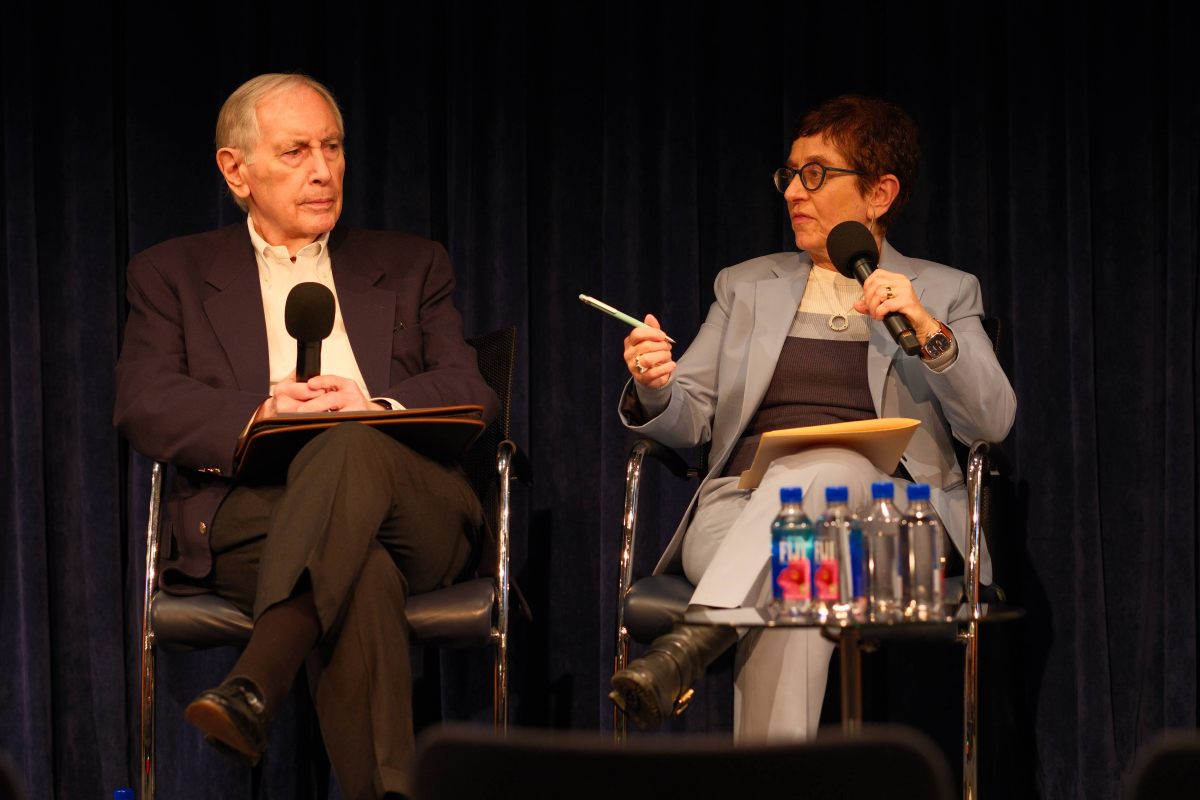
In a fireside chat at the Benton Institute for Broadband and Society’s March 5 event, “Telecom Act at 30”, Benton Senior Fellow and Public Advocate Gigi Sohn spoke with former Deputy Assistant Secretary of State Phil Verveer, who served as lead counsel in United States v. AT&T, the case that led to the breakup of AT&T, about the structural preconditions that led to the Telecommunications Act of 1996.
Breakup of AT&T and the Telecom Act
Sohn began by asking Ambassador Verveer how the AT&T case shaped his understanding of what the 1996 Act sought to accomplish.
“I think it's clear,” Ambassador Verveer said, “that the '96 Act was necessitated, in a sense, by the unsustainability of what had fallen out of the AT&T settlement and the divestiture.”
Ambassador Verveer explained that the Act's structural aspects were enormously important.
“It looked like a pretty clean way of trying to contend with the monopolization issues that were running around loose in the AT&T prosecution, and, in many respects, it was a really successful way of dealing with the problems. The difficulty was that even in a much simpler environment than the one we have today, there were an awful lot of day-to-day questions that still had to be contended with somehow—questions like:
- What kind of interconnection is appropriate, from an architectural, physical perspective, and from an economic perspective?
- How do you contend with the question of universal service funding if the internal subsidy arrangements have been disrupted by virtue of the divestiture?
There were terrifically difficult questions that finally came to a head in 1996, and the way in which those questions were addressed had some really positive aspects and some rather less than positive aspects.”
Universal Service Then and Now
Ambassador Verveer explained that one of the largest aspects of the 1996 Act that needs to be addressed today is universal service, which he admitted has not been handled well over the last 30 years.
Asked who should pay for the Universal Service Fund, Ambassador Verveer said, “As a practical matter, you can fund [universal service] any way you want to fund it. The obvious heritage of what we had for many, many years, when it was an internal subsidy, would suggest bringing broadband into [the contribution base] and finding a way to impose a charge on broadband transmission services, and taking care of the economics of it that way. That would be the simplest way to do it. If you want to bring in large users of broadband transmission networks—those who arguably impose costs on the infrastructure—it obviously gets a good deal more complicated, but Congress could do that if it wished.”
The reality, he said, is that universal service and affordability are issues that have to be addressed.
“If we're going to have a decent, just, and efficient society, we're gonna have to find a way to deal with that.”
Competition vs Regulation
The conversation then shifted to the debate between competition and regulation. Sohn noted that the breakup of AT&T and the 1996 Act were both premised on the idea that competition could achieve what regulation could not, and asked if that premise has held up.
“In the right industrial circumstances,” Ambassador Verveer said, “I think it certainly does. That is to say, if you have a sufficient amount of competition, you will get better outcomes than if you attempt to regulate. The difficulty I think we confront going forward is the question of do we have that level of competition in the sectors and areas we care about—and I think it's fair to suggest we probably don't.”
Sohn explained that antitrust and communications regulation run in parallel—and sometimes in tension.
“In today's market,” she asked, “are the existing tools of antitrust and regulatory law adequate? Do we need to think more seriously about structural remedies, or are there other approaches for this highly concentrated market?”
Ambassador Verveer explained that structural remedies have fallen out of favor and that the marketplace is more complicated than it was in the days of the AT&T breakup, making structural remedies even less likely.
“If that's the case,” he said, “if there are going to be any social controls, they will have to be of a regulatory nature.”
Can AI Be Regulated?
The conversation moved to regulation of AI.
Ambassador Verveer said, “I think eventually we are going to need a regulatory agency for AI—it's almost a dead certainty. We’re not going to be able to rely upon the laws of contract, property, and tort, and figure that everything's going to work out really well in terms of AI. We’re going to have to have some sort of specialized legislation that tries to address the issues AI is going to present, whether we think of them as competitive issues, or we think of them as broader cultural issues, or we think of them as issues of equity, or privacy. But the problem—as has been described over and over again—is that it is really unclear how, at any time in the foreseeable future, we’re gonna have Congress in a position to address what, to be fair, will be really difficult questions.”
Sohn was not as certain that a regulatory agency would be the solution, and asked how to thread the needle between concerns about innovation, speech, and protecting the public.
“I'm certainly not suggesting that I’m sure it can be done or that it can be done easily,” Ambassador Verveer said. “It seems to me that what we would need to do is have a law that has jurisdictional reach that is appropriate, that will have a set of goals that are described in a high-level way with some sort of apparatus that tries to effectuate those goals, that will make adjustments from time to time, as will be required.”
Addressing Sohn’s concerns, Ambassador Verveer said, “We should try to construct an agency only to intervene in the context of aggravated circumstances. Not a quick trigger, but a slow trigger, in terms of intervention. We need some entity with the undoubted ability to intervene in the event of aggravated circumstances. We surely don't have that today.”
Ambassador Verveer suggested that the existing communications law could serve as a template for regulation moving forward, saying,
“I actually think the law provides an interesting template for some sort of regulation going forward, because it basically, not only had a set of purposes that seem like they’re pretty universal and can be adapted pretty regularly, but it also had a set of instructions that, while relatively abstract, gave the agency the opportunity to try to help move things along in ways that were in the public interest for a very, very long time. I think something similar to that, where you have requirements that the way in which the entities subject to jurisdiction proceed in ways that are just and reasonable, not unduly discriminatory, are probably the right kind of ways to think about how we would like to see some sort of social controls going forward with respect to these technologies.”
Also See
- Telecom Act at 30: Act into Action, and Unfinished Business (Grace Tepper)
- Telecom Act at 30: What It Got Right, and What Work Remains (Zoe Walker)
- Universal Service in Action (Sen Ed Markey)
- Making Good on the Promise of Universal Service (Dr. Revati Prasad)
- Thirty Years After the Telecommunications Act, We’re Still Working to Realize the Promise of Universal Service (Dr. Revati Prasad)
- Revisiting the Themes Underlying the Telecommunications Act of 1996 (John Windhausen Jr.)
- History Lessons (Former FCC Chairman Reed Hundt)
Zoë Walker is a Policy Associate at the Benton Institute for Broadband & Society.
The Benton Institute for Broadband & Society is a non-profit organization dedicated to ensuring that all people in the U.S. have access to competitive, High-Performance Broadband regardless of where they live or who they are. We believe communication policy - rooted in the values of access, equity, and diversity - has the power to deliver new opportunities and strengthen communities.
© Benton Institute for Broadband & Society 2026. Redistribution of this email publication - both internally and externally - is encouraged if it includes this copyright statement.
For subscribe/unsubscribe info, please email headlinesATbentonDOTorg

Kevin Taglang
Executive Editor, Communications-related Headlines
Benton Institute
for Broadband & Society
1041 Ridge Rd, Unit 214
Wilmette, IL 60091
847-220-4531
headlines AT benton DOT org
Share this edition:


Broadband Delivers Opportunities and Strengthens Communities