

Telecom Act at 30: Act into Action, and Unfinished Business

Tuesday, March 10, 2026
Digital Beat
Telecom Act at 30: Act into Action, and
Unfinished Business
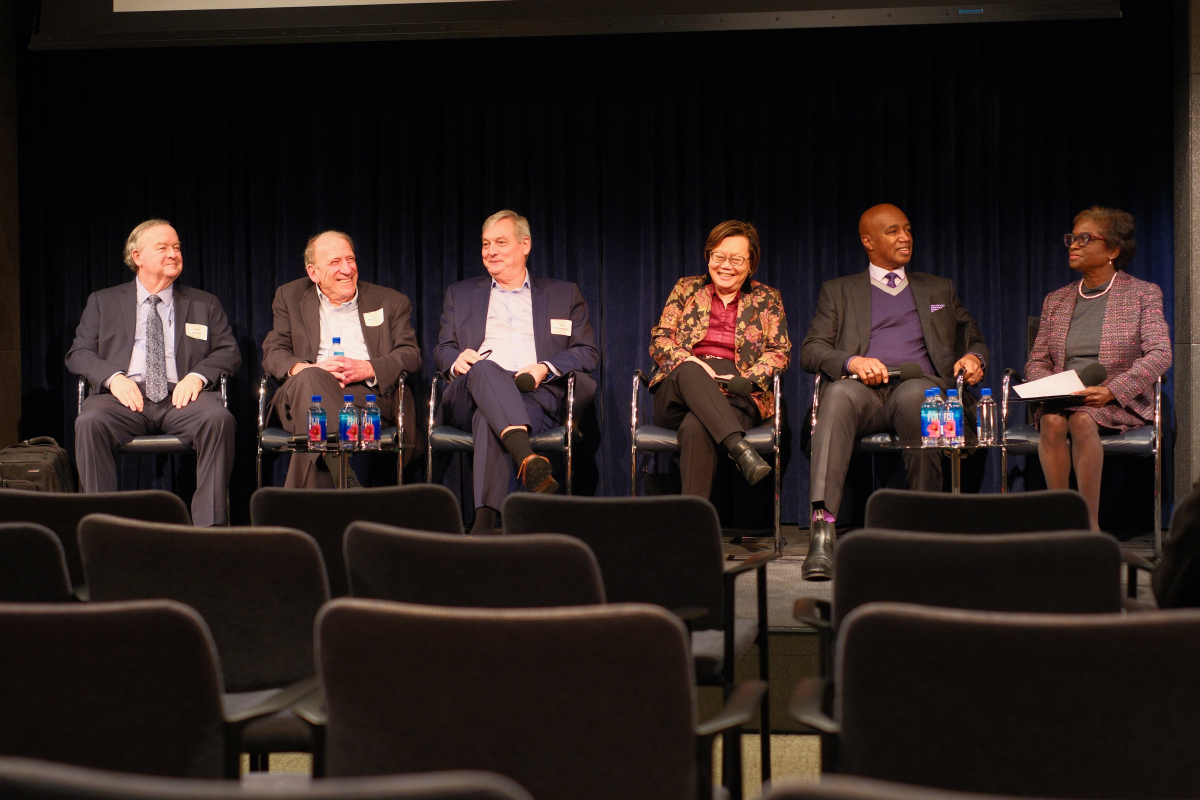
At the second panel of the Benton Institute for Broadband and Society’s March 5 “Telecom Act at 30” event, panelists reflected on the legacy of the Telecommunications Act of 1996 and what the future holds for universal service.
Former Federal Communications Commissioner and Benton Institute Board Member Mignon Clyburn moderated the panel of experts, including former FCC Commissioner Rachelle Chong; President and CEO of the Irving Group, Larry Irving, who headed the National Telecommunications and Information Administration (NTIA) during the Clinton Administration; former Clinto White House Aide and current Benton board member Jim Kohlenberger; Christopher Wright, a Partner at Harris, Wiltshire & Grannis LLP and former FCC General Counsel; and New Street Research Policy Advisor Blair Levin who was the chief of staff at the FCC in the mid-1990s.
Fighting for E-Rate
The panelists spent a lot of time discussing how they fought for the E-Rate Program.
For Rachelle Chong, one of the most contentious moments came when she was an FCC Commissioner.
“You do have to consult with the states when you do something like the E-Rate,” she said. “It was a very contentious issue. I've gotten yelled at probably six times when I was a public servant, and this was the only time I got yelled at by various commissioners, both federal and state, all within maybe 24 hours.”
To her, this signified the necessity of the program.
“It gives you an idea of how passionate people were about this program and how important it was,” said Chong.
Chris Wright discussed the legal battles that took place over the FCC’s authority on universal service. For Wright, the ambiguity built into to the Telecom Act’s language worked for and against the FCC when advocating for E-Rate.
“The FCC is instructed to ‘enhance access to advanced telecommunications and information services for schools and libraries.’ That's a statutory basis for the E-Rate program,” said Wright. “There's nothing about, ‘There shall be a fund, it shall be this large.’”
It took dedicated collaboration and some close calls in the U.S. Fifth Circuit Court to enable E-Rate and uphold the FCC’s authority to create the fund, while universal service was undergoing challenges from “every company in the world,” according to Wright.
Making the Case for the People Through Stories and Data
From the start, the power of the Telecom Act and those fighting to create it came from the stories of people whose lives would change because of it. As the Telecom Act came into effect, those stories were shown on a national level, both quantitatively and qualitatively, for the first time.
During his tenure at the NTIA, Larry Irving’s team was the first to produce an empirical study proving the existence of the digital divide.
For Irving, having the data was a huge step in bringing together policy discussions across all levels of government to spark real action to solve the digital divide.
“We started the first study on who's connected and who's not connected,” he said. “And then we did a series of studies to show that the divide not only existed, but it was increasing. That empirical data helped inform the debates in Congress, debates in states, and debates globally.”
When the Clinton Administration spoke of the need for digital access, policymakers used the story of a girl in Carthage, Tennessee, who would be able to reach the Library of Congress using digital technology. President Clinton signed the Telecom Act into law at the Library of Congress.
“When we signed the bill we did [it at] the Library of Congress as a symbol of that young girl from Carthage, Tennessee accessing the Library of Congress,” said Kohlenberger, a Senior Domestic Policy Advisor in the White House at that time. “She was actually at the first library hooked up under the Telecom Act, I like to say, because we brought in a two-gigabit ATM network so that we could connect the school to the Library of Congress as a metaphor for this whole thing.”
Developing the data and finding the most compelling stories is crucial to advancing policy like the Telecom Act.
“Anytime you got people in real situations with real stories and talked about [how] it was going to change their children's lives, that's when you got [in] contact with those Members of Congress,” said Irving.
“Storytelling is key in being able to [help] people imagine what a vision can be,” said Kohlenberger.
The Digital Divide Was Always More Than Access
Many of the panelists agreed that the digital divide will not be solved unless all of the components––access, affordability, and adoption––are addressed through state and federal support.
“You can get access to everybody, but if they can't afford it, it's useless,” said Chong. “Affordability really has to be done, and that needs to be funded somewhere. We had [the Affordable Connectivity Program], it seemed to have worked pretty well, but it went away.”
Chong added that funding affordable broadband would be better done through the regulatory process in the future, rather than through appropriations.
Irving chimed in on what might happen if access were made available everywhere before it became affordable everywhere.
“What's gonna happen again is we're gonna say the digital divide is cured because we're gonna talk about access for some Americans,” said Irving. “We're not gonna talk about affordability for all Americans, including some of the people who will have access, but unaffordable access.”
Kohlenberger asked about costs:
“How do we transform the conversation from how much does it cost for someone to get online...to the question of how can we afford not having these people online? I think that's the key question for government and society.”
The Meaning of Universal Service is Changing
The discussion delved into the partisan tensions that emerged and ebbed during the creation of the Telecom Act.
For Levin, those distinctions looked a little different than just party lines.
“The real parties are not Democrats and Republicans,” said Levin. “They're people who are universalists, who say everyone does better when everyone does better. And there are tribalists, who [say] the point of politics is to have me dominate, is to have my team win.”
“I would like to believe that universal service is a great example of people coming together and saying, ‘We need everybody to rise up,’” said Levin.
When it comes to the ongoing process of adapting universal service in the modern era and addressing the complex nature of closing the digital divide, Levin highlighted the new challenge of including AI in the conversation.
“There are obvious implications for how we change universal service to an AI age,” he said. “And I just hope we can do it in a spirit of universalism rather than tribalism.”
No Time Like the Present
“The current system, which depends on a shrinking fund, while the demand is growing, is going to eventually hit a tipping point.” - Blair Levin
According to Irving, there’s no time like the present to build on the Telecom Act and everything this panel fought for.
“It took us 60 years from 1934 to 1996 to get the Telecommunications Act revised,” said Irving, referring to the 60 years between the Communications Act of 1934 and the development of the Telecommunications Act of 1996. “It's been 30 years since then…we don't have another 10 or 15 years. We need Members of Congress who can get up and say, ‘We need to do it, and here are some principles we need to be organizing about.’”
Kohlenberger pointed to the question we need to address today, asking:
“How do we make technology a positive force in society?”
Grace Tepper is an Editor and Researcher at the Benton Institute for Broadband & Society.
Also See
- Telecom Act at 30: What It Got Right, and What Work Remains (Zoe Walker)
- Universal Service in Action (Sen Ed Markey)
- Making Good on the Promise of Universal Service (Dr. Revati Prasad)
- Thirty Years After the Telecommunications Act, We’re Still Working to Realize the Promise of Universal Service (Dr. Revati Prasad)
- Revisiting the Themes Underlying the Telecommunications Act of 1996 (John Windhausen Jr.)
- History Lessons (Former FCC Chairman Reed Hundt)
The Benton Institute for Broadband & Society is a non-profit organization dedicated to ensuring that all people in the U.S. have access to competitive, High-Performance Broadband regardless of where they live or who they are. We believe communication policy - rooted in the values of access, equity, and diversity - has the power to deliver new opportunities and strengthen communities.
© Benton Institute for Broadband & Society 2026. Redistribution of this email publication - both internally and externally - is encouraged if it includes this copyright statement.
For subscribe/unsubscribe info, please email headlinesATbentonDOTorg

Kevin Taglang
Executive Editor, Communications-related Headlines
Benton Institute
for Broadband & Society
1041 Ridge Rd, Unit 214
Wilmette, IL 60091
847-220-4531
headlines AT benton DOT org
Share this edition:


Broadband Delivers Opportunities and Strengthens Communities