

Making Good on the Promise of Universal Service

Tuesday, March 3, 2026
Digital Beat
Making Good on the Promise of Universal Service

The Telecommunications Act of 1996 arrived at a pivotal moment in American communications history.
For decades, universal service had meant one thing: ensuring that all Americans could access basic telephone service at affordable rates through a system of implicit cross-subsidies managed largely within the monopoly structure of AT&T and its successors. But by the mid-1990s, this model faced twin pressures. Emerging technologies—from enhanced telephone services to computer networks—created tensions to evolve the definition of “universal service” beyond plain old telephone service. Simultaneously, growing competition in long-distance telecommunications services threatened to undermine the traditional subsidy mechanisms that had made affordable telephone service possible.
Three decades later, the Telecommunications Act of 1996 has delivered enormous gains, though universal service remains a promise yet to be fully realized.
Deployment gaps persist.
Affordability remains elusive for millions of households.
And the system that sustains universal service is eroding; the program's legal and institutional foundations face new challenges.
At the same time, the costs of disconnection are higher than ever.
In 2025, over 20 percent of Americans said they didn’t have home broadband. It is definitely time for some reflection and reevaluation.
The 30th anniversary of the Telecommunications Act presents an ideal opportunity to review the universal service objective, its underlying principles, and the progress made toward its achievement.
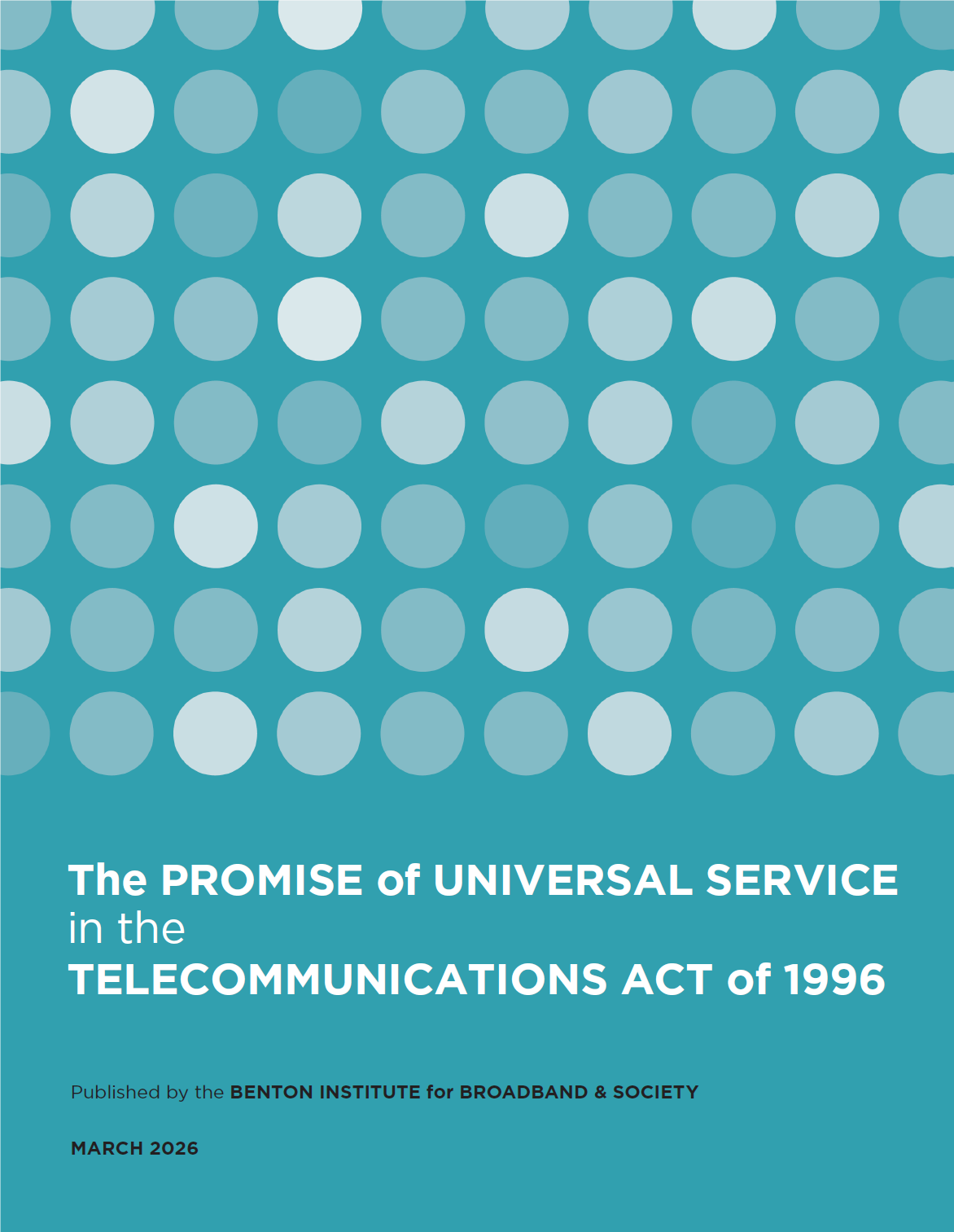 At the time of the law’s passage, public interest advocates were deeply engaged in articulating and advancing a vision for universal connectivity. For our part, the Benton Institute for Broadband & Society gathered leaders, conducted research, and articulated how telecommunications reform could best serve the public interest. We testified before Congress and called on lawmakers to consider how a commercial system of communications could serve noncommercial values, so that the benefits promised by new technologies could be fully realized. We articulated a future with easier access to healthcare, education, government information, and democratic participation. We also warned that such a future would not materialize without the guiding hand of government or the voices of the nonprofit sector.
The 1996 Act reframed universal service as more than a commitment to basic telephone connectivity, articulating a national promise suited to a networked economy. Recognizing that connectivity would be essential infrastructure for work, learning, health, and civic life, Congress outlined the concept of “advanced” services, an approach intended to keep pace with evolving technology. In this way, Congress sought to ensure that the benefits of emerging technologies would not be confined to prosperous communities with profitable markets. Rural communities, high-cost areas, and low-income households were explicitly prioritized. The charge to continually assess what constitutes advanced services set the stage for the Federal Communications Commission’s central task in the years that followed: identifying which services were essential to modern life and determining how competition and public investment could be harnessed to make them available to all.
Now, most Americans have access to advanced telecommunications services, defined (although rarely updated) by threshold speeds reviewed each year by the FCC. The definition of advanced services requires regular reassessment, as envisioned by Congress, to match the pace of technological change.
Truly ubiquitous broadband service has yet to be achieved. There is no consensus on how to determine affordable rates, and the consumer benefit intended to make rates more affordable for low-income households provides, at best, meager relief. More legal challenges to the mechanisms that support universal service are in the courts.
So, this week, Benton is again convening policymakers, advocates, researchers, and industry leaders to examine the lessons of the Telecommunications Act and what they mean as states and communities continue to work to realize the promise of universal connectivity.
We’re calling on all stakeholders to join Benton in a recommitment to ensure that all Americans have access to essential telecommunications services now and in the future.
The conversation starts this week, but will continue in the months and years ahead until we make good on the promise of the Telecommunications Act and of truly universal service.
Join us on Thursday, March 5 for Telecom Act at 30: Universal Service as the North Star
Dr. Revati Prasad is the Executive Director of the Benton Institute for Broadband & Society.
The Benton Institute for Broadband & Society is a non-profit organization dedicated to ensuring that all people in the U.S. have access to competitive, High-Performance Broadband regardless of where they live or who they are. We believe communication policy - rooted in the values of access, equity, and diversity - has the power to deliver new opportunities and strengthen communities.
© Benton Institute for Broadband & Society 2026. Redistribution of this email publication - both internally and externally - is encouraged if it includes this copyright statement.
For subscribe/unsubscribe info, please email headlinesATbentonDOTorg

Kevin Taglang
Executive Editor, Communications-related Headlines
Benton Institute
for Broadband & Society
1041 Ridge Rd, Unit 214
Wilmette, IL 60091
847-220-4531
headlines AT benton DOT org
Share this edition:


Broadband Delivers Opportunities and Strengthens Communities