

Ensuring Broadband Grant Success

Tuesday, March 24, 2026
Digital Beat
Ensuring Broadband Grant Success:
Alabama’s Successful Model for Deployment Tracking and Accountability

The unprecedented broadband funding provided to states by the federal government in the past few years has created a singular opportunity—and the associated imperative to spend the funds well and in a timely way. We in Alabama are proud of our innovative public process for reporting, transparency, and accountability, which ensures timely deployment by grantees and mitigates the risk that missed deadlines could result in funding reverting to the U.S. Treasury.
The Challenge Presented: Deploying Hundreds of Millions of Dollars of Broadband Funding in Short Timeframes
The agency I lead, the Alabama Department of Economic and Community Affairs (ADECA) is the major grant-making entity for our state. ADECA is at the eight-year mark of implementing massive broadband grant programs—innovative in their scale and complexity—to address rural broadband gaps and create new economic opportunities.
The Alabama Digital Expansion Authority (ADEA) was created by Alabama law to advise on broadband expansion matters, and includes representation of the legislature, the executive branch, and other parties.
These programs are delivering value not only for unserved homes and businesses, but also for institutions such as universities, public safety agencies, rural hospitals, and other critical parts of the broader economic and community fabric in the state of Alabama.
Even before the Broadband Equity Access and Deployment (BEAD) Program, ADECA managed many hundreds of millions of dollars in broadband grants through a portfolio of programs using both state and federal funds and supporting both middle- and last-mile connectivity.
For the programs that use federal American Rescue Plan Act (ARPA) funds, we in Alabama (and all the other states) face immovable and onerous time constraints. Grantees must complete construction and activate the networks well before the end of December 2026 to ensure that none of the funding is at risk of being returned to the U.S. Treasury rather than building broadband in Alabama.
Timeline Risks are Shared by ADECA and its Grantees
As we and our counterparts in the other states have learned, broadband deployment inherently carries timeline risks that arise from a range of factors, including the availability of labor and materials; delays associated with federal, state, or local permitting; and delays and costs associated with access to privately owned utility poles and the “make-ready” process required for placement of infrastructure on those utility poles.
In Alabama, we recognized from the start that these potential risks could derail the broadband program timelines and put the funds at risk. We further recognized that many of our grantees have not built under such timeline constraints in the past—and moreover were unfamiliar with federal and state grant reporting requirements.
Our broadband grantees’ limited experience meant ADECA needed a two-pronged approach to ensuring performance:
- First, technical assistance to encourage awardees and help them to perform; and
- Second, transparency and accountability backed by the threat of enforcement action, to ensure that they did perform.
This set of timeline and associated risks forms the backdrop to ADECA’s highly successful public reporting and accountability program.
ADECA Developed a Structure for Reporting, Transparency, and Accountability
With a clear eye on the immovable federal deadline for the funds, our broadband team developed a process of quarterly in-person presentations by all grantees in front of the Alabama Digital Expansion Authority (ADEA)—the entity created by Alabama law to advise on broadband expansion matters and that includes representation of the legislature, the executive branch, and other parties.
Our grantees’ presentations to the ADEA began on a quarterly basis in early 2025. In recent months, we have accelerated the meetings to every 45 days —reflecting the pending federal deadline for ARPA funds. In addition to the grantees, representatives of the Alabama Department of Transportation (ALDOT) and our state’s largest utility pole owner attend each meeting—because they, like the ISPs, are critical partners in the success of our broadband programs.
At the meetings, each awardee addresses the ADEA members and presents a dashboard and supporting materials that describe the awardee’s progress on executing its grant obligations across a range of metrics.
Grant support and accountability cycle
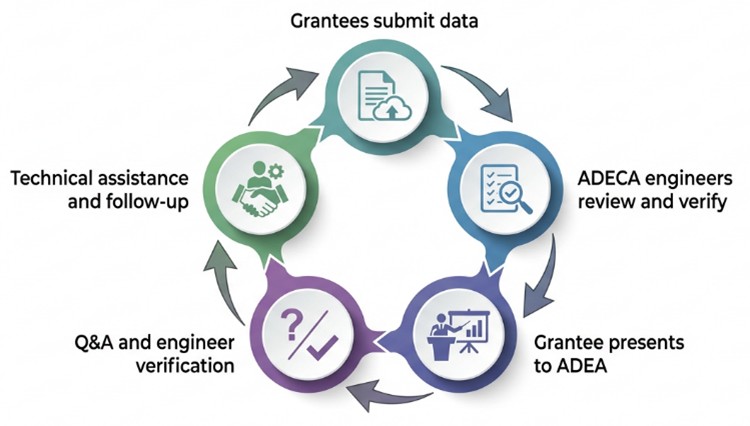
ADECA’s own team develops the dashboard presentation based on materials submitted by the grantees two weeks before each meeting. The pre-meeting submission of the materials allows our engineers to review, vet, and verify the materials—which gives us confidence that the update presented by each awardee is accurate, timely, and not overstated.
To give awardees full opportunity to show the fruits of their efforts, we welcome updated data submission until the morning of the meeting.
ADECA Requires Data that are Not Burdensome to Provide and are Highly Relevant for Showing Progress
Generally, we require our grantees to provide the following categories of data—not just in summary, but with documentary evidence to support their updates:
- High-level design documentation that demonstrates alignment with technical requirements in the award agreements and that demonstrates progress in developing plans for deployment.
- Permits submitted to permitting authorities of all sorts (e.g., state and local agencies, federal agencies, railroads, utility pole owners, and others), calculated as a percentage of total permits needed for the entire project.
- Permits approved, including evidence of approvals by permitting authorities, enabling the state to verify that the permitting hurdle has been entirely cleared and that the grantee has been successful in working with permitting authorities to get to final approvals.
- Redlined as-built map documentation illustrating actual final deployed infrastructure—enabling ADECA to verify, based on these universally developed documents, that construction has actually taken place and allowing ADECA’s engineering team to conduct field inspections.
- Activation and test data, demonstrating that a network has not only been built, but is functional and ready to provide service.
In all of these cases, the documentation we require creates no additional burden for the awardee. All of these documents—including high-level design, permits applications, permit approvals, redlined as-built maps, and so on—are universally prepared in the ordinary course of design and construction of a communications network.
Indeed, we have deliberately designed the documentation requirements so as not to require that new or duplicative documents be created, but rather to leverage documents that are being created in the awardees’ normal deployment processes.
Grantee documentation required for ADEA meetings

After each awardee’s presentation, members of the ADEA have the opportunity to ask questions. This questioning tends to be particularly robust, given that the maps the awardees present allow participants to see the status of deployment at a relatively granular level, including in the districts of the members of the legislature.
After each presentation, too, ADECA’s engineer is asked to verbally verify that the data reviewed by the engineers support the presentation that was just made—or, in the alternative, to raise concerns about missing or inaccurate data.
Benefits
The program is not designed as a trap or a "gotcha" for awardees; rather, it offers a rigorous means—fairly and equally applied—by which awardees can demonstrate their efforts and accomplishments in return for public grant dollars. We do everything we can to help our grantees to achieve success and to show that success through this program. Our broadband team makes itself and its engineers available for technical assistance between meetings and offers ongoing opportunity for grantees to collaborate with ADECA to achieve best-case outcomes.
Benefits of the ADEA public meeting process

This process provides a forum of considerable transparency and accountability. The grantees are required to share their efforts and progress to date with the public and ADEA, and the state can identify grants that may be at risk of missing critical deadlines.
The accountability is key: For those grantees that are making progress and sharing relevant data, the outcome is awareness by ADEA and the public of their efforts, and confidence in their relationship with ADECA. For the grantees that are not making adequate progress on their funded projects, this process provides an additional incentive to make their best efforts and prioritize their Alabama grants.
This public set of meetings and processes has also had significant additional benefits that have been critical parts of our ability to mitigate against timeline risks for these programs. These benefits have arisen from the in-person discussions (both formally in front of the ADEA and informally before and after each ADEA meeting) among our grantees and the various public and private permitting entities on which they rely to be able to proceed with building their networks and meeting our timelines.
Among other important outcomes, these meetings have resulted in agreements among utility pole owners and ISPs regarding make-ready timelines and costs; shared information and best practices among ISPs regarding strategies for accelerating slow-moving railroad permits; and a highly successful collaboration between ADECA and ALDOT to provide financial resources to ALDOT to facilitate and centralize permitting.
In addition, this in-person discussion of deployment challenges leads to productive and positive interventions. For example, when we learn of delays caused by specific permitting authorities, ADEA is able to reach out to local elected officials or other decision-makers to seek intervention and action.
In sum, the reporting and dashboard are enormously valuable in and of themselves because they elevate issues and bottlenecks. Beyond that, however, they are even more valuable in that they lead to new agreements, collaboration, and solutions.
Building on this Process to Maximize the Success of the BEAD Program
We in Alabama are confident that the success of this initiative provides a blueprint for the BEAD Program, which will involve even more risk and challenge than earlier grant programs for a few reasons.
First, ISPs are finding that the availability of optical fiber—the cables needed for many BEAD deployment projects—is exceptionally low. Hyperscalers such as Meta and Google are not just absorbing all available capacity of fiber supply for their own efforts; they are pre-reserving supply into the future. This availability crunch may create significant risks to the BEAD timeline if supply issues extend beyond six to 12 months.
Second, BEAD involves regulatory and federal permitting processes that were not contemplated under the ARPA-funded programs, including compliance with the National Environmental Protection Act and the National Historic Preservation Act. These requirements will be new to most of our grantees and will require time and resources to address. Meeting these requirements will mean extensive consultations and time-consuming processes by both states and their awardees. The BEAD timeline will face particular risk if these processes extend beyond the first year of the BEAD deployment period.
Third, BEAD involves timeline risks that arise from the complexity of serving the areas that will see terrestrial deployment. These projects will connect many of the hardest-to-reach and most remote locations in almost every state (earlier grant programs picked up the easier-to-reach locations that were still unserved or underserved).
Given these considerable risks to the BEAD timeline, even in light of the relatively generous four-year deployment period, the accountability process I have described above represents a methodical, proven means of ensuring both transparency and accountability, and creating an opportunity for state actions to solve problems before they become significant delays—enabling win-win-win outcomes for our state government, our localities, and our BEAD grantees.
Kenneth W. Boswell is Director of the Alabama Department of Economic and Community Affairs
Follow broadband developments in Alabama
See Also:
- A Progress Report on Broadband Access in Alabama
- Linking Alabama to Broadband With a Digital Equity Capacity Grant
- The ABCs of Affordability in Alabama
- Envisioning a Connected, Interconnected Alabama
- Connect Alabama Gets Help From Capital Projects Fund
The Benton Institute for Broadband & Society is a non-profit organization dedicated to ensuring that all people in the U.S. have access to competitive, High-Performance Broadband regardless of where they live or who they are. We believe communication policy - rooted in the values of access, equity, and diversity - has the power to deliver new opportunities and strengthen communities.
© Benton Institute for Broadband & Society 2026. Redistribution of this email publication - both internally and externally - is encouraged if it includes this copyright statement.
For subscribe/unsubscribe info, please email headlinesATbentonDOTorg

Kevin Taglang
Executive Editor, Communications-related Headlines
Benton Institute
for Broadband & Society
1041 Ridge Rd, Unit 214
Wilmette, IL 60091
847-220-4531
headlines AT benton DOT org
Share this edition:


Broadband Delivers Opportunities and Strengthens Communities