

The Department of Labor Does AI 101

Friday, April 10, 2026
Weekly Digest
The Department of Labor Does AI 101
You’re reading the Benton Institute for Broadband & Society’s Weekly Digest, a recap of the biggest (or most overlooked) broadband stories of the week. The digest is delivered via e-mail each Friday.
Round-Up for the Week of April 6-10, 2026

On March 24, the U.S. Department of Labor (DOL) launched its “Make America AI-Ready Initiative” with a seven-day artificial intelligence (AI) literacy course brought to learners via text messages on their cellphones. The course, developed through a public-private partnership between DOL and education technology company Arist, is intended to introduce the workforce to basic AI literacy concepts so all workers can “benefit from the opportunities that the AI economy presents,” according to U.S. Secretary of Labor Lori Chavez-DeRemer.
DOL’s course is designed to support the five foundational content areas outlined in its recently released AI Literacy Framework and serve as a “starting point for American workers in their AI journey.”
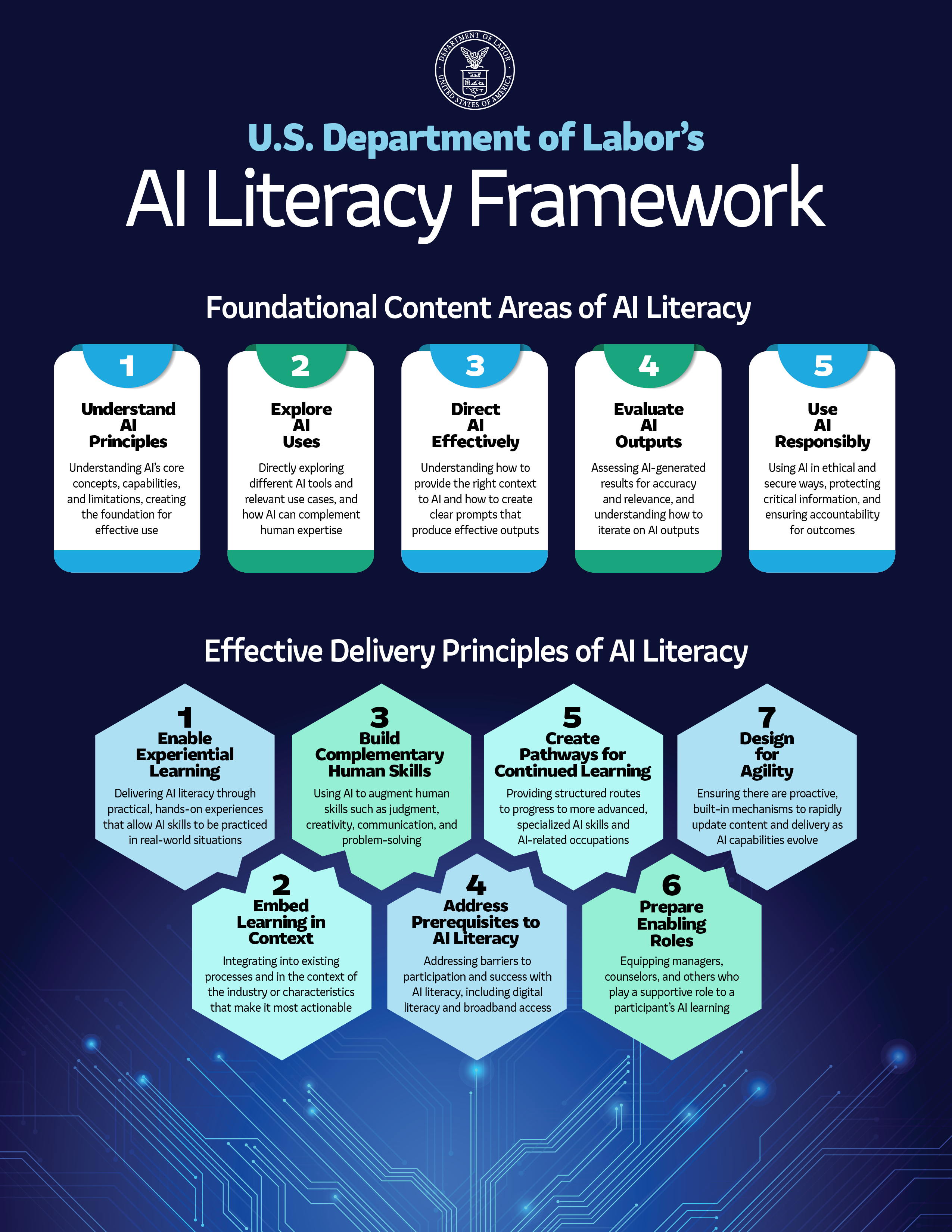
DOL’s AI literacy course is intended to be a baseline platform—meant for all workers across occupations, skills, and levels of educational attainment—through which anyone can learn to use AI. The course poses interesting questions about how to upskill and reskill workers, how the federal government views AI use on the job, and how to work with the current limitations of generative AI tools.
Basic Literacy that Supports a Nationwide Strategy
The Make America AI-Ready course follows the principles of DOL’s AI Literacy Framework:
-
Understand AI Principles (Days 1-2): Understanding AI's core concepts, capabilities, and limitations, creating the foundation for effective use.
-
Explore AI Uses (Day 3): Directly exploring different AI tools and relevant use cases, and how AI can complement human expertise.
-
Direct AI Effectively (Day 4): Understanding how to provide the right context to AI and how to create clear prompts that produce effective outputs.
-
Evaluate AI Outputs (Day 5): Assessing AI-generated results for accuracy and relevance, and understanding how to iterate on AI outputs.
-
Use AI Responsibly (Days 6-7): Using AI in ethical and secure ways, protecting critical information, and ensuring accountability for outcomes.
DOL’s AI Literacy Framework is meant to advance the Trump Administration’s Talent Strategy and AI Action Plan, both of which present AI usage as a prime vehicle for upward economic and workforce mobility.
Delivery via text message makes the course accessible to most people, including those without wireline internet access or a large-screen device, such as a laptop. The Pew Research Center finds that 78 percent of U.S. adults subscribe to broadband internet at home and 91 percent own a smartphone, allowing the vast majority of U.S. residents to take DOL’s course.
The course is delivered via 4-6 text messages delivered at a consistent time each day. Depending on the lesson, the messages include about three multiple-choice questions for learners to answer as they read the material. Learners must respond to the questions to proceed with the course, which is presented as a 10-minute daily commitment. Each lesson ends with a suggested activity using generative AI. The suggested activities expose learners to AI tools relevant to the lessons and may also include YouTube videos featuring different AI use cases.
1. Understanding AI Principles
The first two days of the course are all about understanding how AI works—specifically, generative AI, which can create original content in response to a user’s prompt or request.
The course begins by trying to demystify AI tools, acknowledging the many ways AI is already part of the technological landscape, such as in the algorithms of social media networks or in predictive text that suggests how to write an email. The course defines AI broadly as “a system that looks at massive amounts of data, finds patterns, and makes predictions.”
To highlight AI tools' limitations, the messages briefly explain AI hallucinations—instances in which an AI agent offers made-up quotes or facts as a result of its predictive behavior, despite having no way to verify those predictions.
The course thus introduces two of its repeated, core messages: 1) AI tools are powerful and full of possibilities, and 2) users are responsible for all aspects of the outputs of their AI usage.
Two intake questions establish a baseline for measuring performance in the course. Learners are asked how much they currently understand AI and how comfortable they are using it in their daily lives, on a scale of 1 (not comfortable) to 10 (most comfortable). Learners are also asked how often they use AI platforms (ranging from never to multiple times a day), with ChatGPT, Claude, Google Gemini, or Grok provided as examples. In general, the course doesn’t drive learners to any specific AI tool, encouraging them to use the chatbot they prefer.
2. Explore AI Uses
On the third day, the course explores how to use AI tools, with a focus on prompting techniques.
DOL highlights how different prompts lead to different outputs:
- When ordering food, simply saying, “I want food” could result in an AI tool suggesting someone eat a raw turnip or an infinite number of other things, while asking for a “medium pepperoni pizza with extra cheese” will yield more specific results.
- Asking AI to write something about your business will yield generic results, but specifying details like “Write a 3-sentence pitch for my landscaping business that targets homeowners in Dallas” will yield something more tailored to your experience.
Optimal results are “completely in your control,” the course says, “and the more specific the question, the better the result.”
The course also states that “many bad AI experiences can be traced back to the prompt,” suggesting that AI platform failures stem from incorrect inputs. In this way, the course conveys a key theme: that the user has control over the AI's output, its accuracy, and its usefulness.
3. Direct AI Effectively
On the fourth day, the course aims to hone prompting skills to achieve more productive AI interactions.
DOL’s course outlines three parts to a strong prompt:
- A Goal: What do you want AI to do (write, summarize, plan, explain, compare, or organize)?
- Context: What relevant details should AI know about your situation?
- Expectations: What do you expect the result to look like in terms of length, tone, and format?
The course gives an example of how to incorporate these parts in practice: instead of telling an AI platform, “fix my house,” a prompt like “Replace the broken tile in the upstairs bathroom, match the existing white subway tile, budget under $200” might yield more productive results.
The course encourages the use of AI for household maintenance and labor, workforce development, and improvements in communication, such as email.
The examples given in this lesson continued to follow the same themes: using AI to help with daily tasks, career development, financial planning, or to communicate with others.
4. Evaluate AI Outcomes
Five days into DOL’s AI literacy course, learners move from the basics of how generative AI works and how to prompt it into more applied functions. Here, the course introduces learners to various AI tools designed to accomplish specific goals.
Learners are encouraged to outsource a variety of tasks to AI, which the course markets as a time-saving exercise. Importantly, DOL also encourages users to put their own spin on AI-generated content. “AI can provide structure and ideas, but your judgment is what makes them meaningful,” says the course. “That’s the AI + human formula.”
With this in mind, the messages list a variety of AI tools for specific purposes:
- Chatbots (ChatGPT, Claude, Gemini, Grok): Draft content, answer questions, brainstorm, and role-play conversations.
- Research Assistants (Perplexity, NotebookLM, Elicit): Dig deeper, summarize sources, and explore different perspectives.
- Creative Tools (DALL·E, Midjourney, Canva): Create images, edit photos, and design quick graphics.
- Data Helpers (Julius, Datawrapper, Flourish): Analyze numbers, generate formulas, and visualize data.
Many of these tools are information work-oriented, built for research, data science, engineering, and analysis, skills that are not necessarily universally applicable to all jobs.
The course messages also suggest that some topics are too important to leave to AI. One use case example: a chatbot user asks an AI platform for medical advice. The course encourages learners to use AI tools as a starting point to learn more information, but to see a real doctor for real decisions.
5. Use AI Responsibility
The last two lessons focus on information verification and responsible use. These lessons frame AI safety as one part of general information literacy.
The course provides four dimensions on how to verify AI content:
- Accuracy: Verify facts, names, and statistics.
- Completeness: Ensure an AI platform’s response covers everything it was prompted to address.
- Relevance: Make sure an AI platform’s response is appropriately tailored to the user’s goal.
- Soundness: Watch for advice or content that sounds smart but falls apart in real life.
The course emphasizes that AI can and will make mistakes, and that it’s the user’s responsibility to identify them and adjust their prompts to reduce them.
One last important warning: learners should never enter confidential data (financial details, account numbers, or personal identifiers) into external AI tools, as users may lose control of how it’s stored or used.
What Can This Course Really Do?
If someone stumbles across this course with little AI knowledge and/or literacy, they may gain a basic understanding of how generative AI works and what it can do.
But the course does not do a great job of addressing online safety, which is imperative to internet use. The responsible-use content in the course is limited: Don’t put sensitive information on the internet, and employ basic information literacy skills to identify factual errors and spot inaccuracies.
Ultimately, telling learners to beware the pitfalls of AI use is not the same as training them to spot them. The course ends with a reminder that it’s up to AI users to catch mistakes and avoid harm online. However, for those who lack basic information literacy and for those struggling with digital literacy and the digital divide, that may be an impossible task.
The course is intended for all workers across occupations, skills, and levels of educational attainment. However, its lessons seem most relevant to workers aged 18 or older with some familiarity with AI platforms, especially those in office-based professional roles in administration or science, technology, engineering, or math (STEM) fields.
Attempting to be broad by offering work-related and non-work-related examples of AI use, the course lacks specificity about how those in trade roles or other labor sectors could engage in upskilling through AI tool use, should they choose.
Ultimately, it’s unlikely that all members of the workforce would get the same value out of this course, and it’s unlikely that the course will cause widespread change in workforce readiness for AI adoption, both of which DOL states as course goals. But it aligns well with the Trump Administration’s approach to AI, which seeks to promote AI literacy to support adoption.
Where the course is effective is its ability to expand AI understanding and adoption among people with just a basic understanding of the technology. And this is really the only aspect that DOL builds into the evaluation—to measure outcomes, the course’s final lesson asks users how often they use AI tools once again, as well as how confident they feel using AI in their daily lives.
Quick Bits
- What AI does to truth
- AI's impact on the job market is starting to show up in the data
- Universal Service Fund's renewed legal challenge spotlights need for reform
- Governor Newsom turns on largest public broadband network, California connects first rural community to internet
Weekend Reads
- 50 U.S. States Broadband Speed Performance
- Use of digital distress metrics to assess digital exclusion can obscure vulnerable groups: the case of migrant and seasonal farmworkers in North Carolina
- Industrial Policy for the Intelligence Age: Ideas to Keep People First
- Users of social media and AI chatbots for health information are more likely to say they are convenient than accurate
ICYMI from Benton
- Community Anchor Institutions: The Real Engines of Digital Equity
- The FCC Asks, "Are Broadband Markets Competitive?"
- Is New York’s Affordable Broadband Act Working?
- No Lifeline for the Dead
Upcoming Events
Apr 14—Executive Session (Senate Commerce Committee)
Apr 14—From Spectrum to Service: Building with Unlicensed Fixed Wireless (National Telecommunications and Information Administration)
Apr 15—Oversight of the Federal Trade Commission (Senate Commerce Committee)
Apr 15—Inside the Data: Usage Trends Shaping Connectivity (Georgetown University)
Apr 15—Computing Power and Competition: Examining the Semiconductor Ecosystem (House Commerce Committee)
Apr 15—Transforming Rural Health: Understanding and Leveraging the Rural Health Transformation Program (Schools, Health & Libraries Broadband Coalition)
Apr 16—American Connectivity Forum 2026 (USTelecom)
Apr 22—Screen People (New America)
Apr 23—Making AI Work: Productivity, Diffusion, and Policy (Georgetown University)
Apr 30—April 2026 Open Federal Communications Commission Meeting (Federal Communications Commission)
The Benton Institute for Broadband & Society is a non-profit organization dedicated to ensuring that all people in the U.S. have access to competitive, High-Performance Broadband regardless of where they live or who they are. We believe communication policy - rooted in the values of access, equity, and diversity - has the power to deliver new opportunities and strengthen communities.
© Benton Institute for Broadband & Society 2026. Redistribution of this email publication - both internally and externally - is encouraged if it includes this copyright statement.
For subscribe/unsubscribe info, please email headlinesATbentonDOTorg

Kevin Taglang
Executive Editor, Communications-related Headlines
Benton Institute
for Broadband & Society
1041 Ridge Rd, Unit 214
Wilmette, IL 60091
847-220-4531
headlines AT benton DOT org
Share this edition:


Broadband Delivers Opportunities and Strengthens Communities