

Starlink: What It Is, How It Works, and What We Should Do About It

Wednesday, July 8, 2026
Digital Beat
Starlink: What It Is, How It Works, and What We Should Do About It

Starlink is all over the broadband news lately. The SpaceX-owned broadband provider has come a long way since it first launched 60 satellites in May 2019. Today, SpaceX has more than 10,000 satellites in orbit and has received regulatory approval to grow the fleet to 15,000. The company reports over 9 million direct subscribers globally (2.7 million in the U. S. alone), a number experts think is poised to grow exponentially in the coming years. In a recent SEC filing, Starlink claimed it can reach 3.3 billion potential users now.
Starlink’s rapid growth has not come without controversy, much of it centered around SpaceX’s founder Elon Musk, the world’s first trillionaire. Musk’s political dealings have caused some users to discontinue their service. However, the company is a financial juggernaut: Starlink was the centerpiece of the SpaceX IPO, the largest IPO in history. Right now, Starlink is SpaceX’s only profitable business. Starlink is a big player in home internet and mobile services, already reaching the 7th largest consumer base in the US since the first satellite launched in 2019. At the same time, Starlink has been at the center of geopolitical attention worldwide, namely in the Russo-Ukrainian War and during Iranian protests. On top of that, reports of price hikes and poor service mire the company.
Regardless, Starlink also receives high acclaim from many users. The company can connect people in remote and isolated places that have long lacked service. The ability to quickly connect users is a major boon in emergencies.
But how does Starlink work? And what are the major advantages, disadvantages, and policy considerations? This piece describes how the service works, the pros and cons of Starlink, where it stands in the US policy ecosystem, and the policy considerations for the broadband world.
How Starlink Works
Starlink is the first operational low-Earth orbiting (LEO) satellite broadband provider.[1] Traditional satellite broadband is powered by a small number of high-orbiting satellites, also called geostationary (GEO) satellites. Picture each satellite putting out a ‘cone’ of service: the higher up the satellite is, the larger the cone, and the more coverage each individual satellite provides. However, the high orbits mean data must travel longer distances, and there are more obstacles that could interrupt service, leading to slow speeds.
In contrast, LEO satellites are much closer to Earth, so each satellite covers a much smaller ‘cone’ of service. Because of this LEO service networks require significantly higher numbers of satellites. Compared to Starlink’s 10,000 satellites, traditional satellite industry leader ViaSat has only 19. GEO satellites orbit at an altitude above 35,000 km, while LEO satellites are much lower, between 160-2,000 km. LEO satellites travel much faster than GEO satellites, 27,000 km/hr compared to about 11,300 km/hr. The vast numbers of LEO satellites needed to establish the network—what Starlink calls a ‘constellation’—enable high service coverage.
There are three components required to connect to Starlink service at home: 1) ground stations (also called gateways), 2) satellites themselves, and 3) home terminals. The three function together in a series of relays: The ground station connects the satellite to Internet, and the now-connected satellite gets service to the home terminal. The user sends data to the satellite, which routes the data to the Internet by sending it back to the ground station.
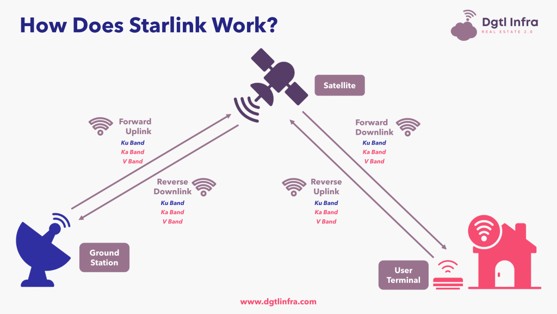
Source: DgtlInfra
The ground station connects the satellite to the Internet by sending a data signal up through the air. The user purchases a terminal from Starlink, which is delivered to the home. For self-installation, the user must find a place with a 110°-degree view of the sky, avoiding obstacles like trees and buildings. Once the terminal is turned on, it begins communicating with the satellites, connecting the home to the Internet.
If the user wants to upload something, the data is communicated to the satellite, which then returns it to the ground station for its final destination on the Internet. The ground station and the home terminal never talk to each other, exchanging data exclusively through the satellite.
Home terminals “beam switch,” connecting to the closest LEO satellite as the constellation moves. This improves the latency, or “the delay between sending a request and receiving a response online,” of service as the LEOs orbit. Ground stations also beam switch, connecting satellites based on proximity.
Advantages of Starlink
Starlink’s LEO service has one undeniable advantage: now that much of the Starlink constellation is up, connectivity is instant. In Starlink coverage areas, which include massive swaths of the United States, you can get home Internet service as soon as you have a home terminal. With the satellites in orbit and ground stations built, there is no extra infrastructure that needs to be built to connect a home. Now that much of the constellation is in place, the satellites have a big advantage over terrestrial projects, which have long construction periods—fiber takes 6-10 months to deploy, from project approval to construction completion.
The instant connectivity makes Starlink a great option in emergencies. After Hurricane Helene, the Federal Emergency Management Agency (FEMA) disbursed Starlink terminals to assist in emergency reconnections. Starlink has also been deployed advantageously in the Russo-Ukrainian War, where Starlink powered Ukrainian drones after ground infrastructure was destroyed.[2]
Another major advantage for Starlink is that it is inexpensive at the infrastructure level. While launches and satellites are of course costly, exact costs are difficult to track. SpaceX CEO Gwynne Shotwell said in a TED Talk that she believes the cost will be $10 billion for the total constellation, which will have worldwide coverage.
Costs of terrestrial broadband are massive. Making one-to-one cost comparisons between LEO and terrestrial broadband is difficult due to the major differences between what is required infrastructurally. For context, the Broadband Equity, Access, and Deployment (BEAD) Program intended to connect all United States locations to broadband—preferably fiber—networks and was funded to the tune of $42.5 billion.[3] The vast differential between the estimate of Starlink’s entire constellation and the investment (intended) for largely fiber terrestrial networks indicates the cost differential: LEO is less expensive infrastructurally. For Starlink, the existing satellites report coverage of those same miles since they are already deployed, meaning costs come primarily from replacing satellites as they retire about every five years.
Fiber requires investments in areas with no terrestrial coverage, while Starlink can rely on existing constellations and potentially supplement with further launches, while fiber construction starts from zero. These network deployment issues make Starlink a heavy favorite among some conservative policymakers.
In 2024, Federal Communications Commission Chairman Brendan Carr (then an FCC Commissioner) tweeted about BEAD, saying that the program was deploying too slowly and not providing Americans with connections. In response, Musk wrote “Starlink could do it literally infinitely cheaper,” highlighting the infrastructure investment already made by SpaceX.[4] Indeed, Starlink’s emergence has already been influential for federal broadband policymaking.
Disadvantages of Starlink
Starlink isn’t cheap for end-line users. The costs come in two parts: the initial home terminal investment and the monthly service fee.
The initial terminal costs between $300 and $1,999, depending on performance needs. The steep up-front cost is high, perhaps the reasoning for Starlink’s recent announcement that a monthly hardware rental fee will be available in lieu of the initial investment, though this comes at the disadvantage of the user renting the hardware, instead of outright owning the terminal. There is an optional $199 installation fee as well.
After the hardware, there’s the monthly service cost. For standard residential service, costs currently vary between $50 and $165 a month depending on data needs and geographic area. The national average is around $81 a month. These costs increase exorbitantly when subscribers enroll in local or global priority plans. More expensive plans place users into priority categories of Starlink’s data tiers, which leads to higher speeds at the cost of up to $2,150 a month.
Starlink may provide connectivity, but speed, latency, and congestion are concerns. Just 44.7 percent of Starlink users enjoy the threshold speeds for broadband as defined by the FCC. While performance has improved over past years, LEO is still nowhere near the speed of service provided over fiber networks. Starlink users also report issues with latency. Starlink users experience higher latency than traditional terrestrial broadband users. The company is working to address the problem, but the nature of satellites still presents concerns for latency especially when there are line-of-sight obstructions, weather issues, or during beam switching. LEO satellites also have less technological capability for connection than terrestrial broadband technologies, like fiber, causing congestion (slow-downs) when too many users try to connect. Starlink has tried to remedy this with congestion fees in high-traffic areas and waitlists to get service, but those are both ultimately roadblocks to getting people connected to affordable service.
Beyond potential cost and performance concerns for subscribers, space experts are concerned about the environmental impacts of the high number of satellites in the Starlink constellation. The high concentration of satellites is linked to air quality issues, light pollution, radio wave disruption, and general pollution and junk from both launches and falling satellites. Satellite launches are also major polluters, with massive amounts of carbon emitted. Light pollution is of particular concern to scientists, whose research is affected by satellites’ orbits.
“This is a lot of satellites, but it's only the beginning,” said Astrophysicist Jonathan McDowell about the rate of LEO satellite deployment. “They'll ask for more. China will throw a lot up. Other companies and countries will throw stuff up. We're going to pass the 100,000 mark most likely.” Recent filings to the FCC confirm McDowell’s fear, as SpaceX’s proposed ‘orbital data center’ would require up to one million satellites.
Satellite traffic in space also presents two primary safety risks: debris and space collisions. Increase in debris presence is “exponentially worse” after the LEO satellite boom, with scientists estimating 25,000 objects greater than 10cm are orbiting Earth. Satellites that break up, which has happened with Starlink, pose a risk of becoming debris. The amount of debris and traffic creates collision risk. The problem is so well-known that the ABC procedural 911 aired an episode on LEO collision risk. Satellite collisions release more debris, and can be dangerous to people if objects fall out of orbit. A Chinese rocket recently narrowly avoided collision with a Starlink satellite. This risk is poised to increase, especially as competitors like Amazon Leo, which won FCC approval for over 7,500 satellites, begin or continue launches.
The Questions Facing Policymakers
LEO, like any technology, has both advantages and disadvantages. As the new regulatory landscape under President Trump and Chairman Carr progresses, Starlink raises some major policy questions, encompassing both the benefits and drawbacks of the technology.
Starlink and Politics
Even before President Trump took office a second time, the broadband policy landscape was expected to change. Elon Musk was a Trump campaign supporter and later head of the Department of Government Efficiency (DOGE). In the chapter of Project 2025’s Mandate for Leadership chapter on the FCC, now-FCC Chairman Brendan Carr wrote that LEO providers, specifically Starlink and Amazon, should be major players in rural broadband and that FCC regulations should be changed to favor these companies.
The FCC has delivered wins to Starlink. The agency granted Starlink authorization for use in moving vehicles. This move enabled Starlink to score lucrative contracts with businesses like American Airlines and United Airlines to offer in-flight Starlink on many flights. The FCC approved Starlink to become a 5G carrier, opening up huge revenue potential. SpaceX has also received numerous Pentagon contracts, under both Presidents Biden and Trump, for Starshield, the so-called ‘military-grade Starlink’ that functions to provide ‘Earth observation’ for the U.S. government.
What about BEAD?
The Infrastructure Investment and Jobs Act made unprecedented funding available for broadband deployment and affordable internet service. The BEAD Program, created by this legislation, is a $42.5 billion broadband deployment program. Initially, BEAD had a fiber-first policy under President Biden, meaning fiber broadband projects would be prioritized for support. Under the Trump Administration, BEAD switched to a “technology-neutral” approach that prioritizes the cheapest infrastructure projects. This privileges LEO, as Starlink’s satellites are already deployed.
As it stands, Starlink has been awarded $661 million in BEAD funds so far. Some states reversed plans to expand fiber infrastructure after considering the new criteria.
Universal coverage?
In May 2026, the FCC launched a rulemaking that notes that “low Earth orbit (LEO) satellite systems… offer ubiquitous, low latency broadband service at speeds of at least 100/20 Mbps.” Starlink told the FCC that with its service, “the long-standing problem of high-speed broadband network access has effectively been solved.” Starlink questions how government programs, namely the Universal Service Fund High Cost Programs, which assist in deploying broadband infrastructure in unserved areas of the U.S., will function in the future. SpaceX suggests that the existence of Starlink should put an end to High Cost Programs that deploy network infrastructure, including fiber, as Starlink already offers service.
The disadvantages of Starlink—user costs, speeds, and reliability—are still present throughout its coverage areas. Many policy advocates argue that the gold standard of universal service should be universal fiber networks, saying that services provided over other technologies only constitute ‘good enough’. Compared to both Starlink and terrestrial alternatives fiber is faster, more consistent, and ‘future-proof.’
Where We’re Going
The next few years bring two major policy questions to the forefront: (1) BEAD performance testing and (2) the potential of Starlink as a mobile broadband provider.
LEO companies, including Starlink, have been awarded BEAD funding. All subgrantees (ISPs receiving BEAD support) are subject to obligations, including that their service meets the minimum broadband threshold speeds. States are required to conduct testing throughout the “deployment period,” meaning the period where companies are deploying their internet service, though not after. States also largely design their own testing schema. Failing testing can lead to unspecified remedial actions from states against subgrantees. As BEAD funds are disbursed and ISPs begin to deploy their networks, how states test LEO service, and how LEO providers perform, will be important to watch.
There are currently three major mobile providers in the United States: AT&T, T-Mobile, and Verizon. In 2025, the FCC granted approval for T-Mobile customers to access Starlink text messaging service on mobile devices, marking the first use of LEOs for mobile coverage. Starlink touts its mobile service capability, calling itself a ‘cellphone tower in space.’ Usage tests indicate a slowly growing customer base. LEOs’ slow service reportedly impedes Starlink’s mobile network progression, with video calls especially cited as an issue.
As of now, this service seems focused on partnerships, with Starlink having established mobile provider partners in over twenty nations. Starlink continues to pursue FCC approvals, this year being granted the authority to continue deploying its ‘NextGen Constellation’ aimed specifically at mobile service. Whether Starlink will operate its own independent (unpartnered) mobile network remains to be seen.
Abby Simmerman is a doctoral student specializing in critical study of telecommunications at Penn State University. She is a COMPASS Fellow at the Benton Institute for Broadband & Society.
Notes
[1] Starlink is not the only company that provides LEO internet service. Notably, Amazon is working on developing an LEO service and another network, Eutelsat, has 600 LEOs in orbit. Since competitor networks are smaller in scope or still in development, LEO internet at this point is near exclusively provided by Starlink.
[2] This would later become mired in controversy as allegations of Musk denying service to Ukraine rose.
[3] Fiber deployment costs between $27,000 and $100,000 per mile The cost is varied because fiber deployment projects are different in different geographies and circumstances (urban or rural, etc.). This makes determining exact costs complex. For further reading on variable costs of fiber, see Christopher Ali’s Farm Fresh Broadband (2021).
[4] Chairman Carr and Musk have a close relationship, which has made experts question Carr’s decisions and statements surrounding Musk’s companies.
The Benton Institute for Broadband & Society is a non-profit organization dedicated to ensuring that all people in the U.S. have access to competitive, High-Performance Broadband regardless of where they live or who they are. We believe communication policy - rooted in the values of access, equity, and diversity - has the power to deliver new opportunities and strengthen communities.
© Benton Institute for Broadband & Society 2026. Redistribution of this email publication - both internally and externally - is encouraged if it includes this copyright statement.
For subscribe/unsubscribe info, please email headlinesATbentonDOTorg

Kevin Taglang
Executive Editor, Communications-related Headlines
Benton Institute
for Broadband & Society
1041 Ridge Rd, Unit 214
Wilmette, IL 60091
847-220-4531
headlines AT benton DOT org
Share this edition:


Broadband Delivers Opportunities and Strengthens Communities