

How Are Teens Using AI Companions?

Thursday, July 24, 2025
Digital Beat
How Are Teens Using AI Companions?
New Research from Common Sense Media

Artificial intelligence (AI) is becoming increasingly pervasive and is assuming a new role for teenagers in the U.S.––that of a social companion. AI companions, digital friends or characters that you can text or talk with whenever you want, are being used more and more by young people nationwide. Unlike regular AI assistants that mainly answer questions or do tasks, AI companions are designed to have conversations that feel personal and meaningful.
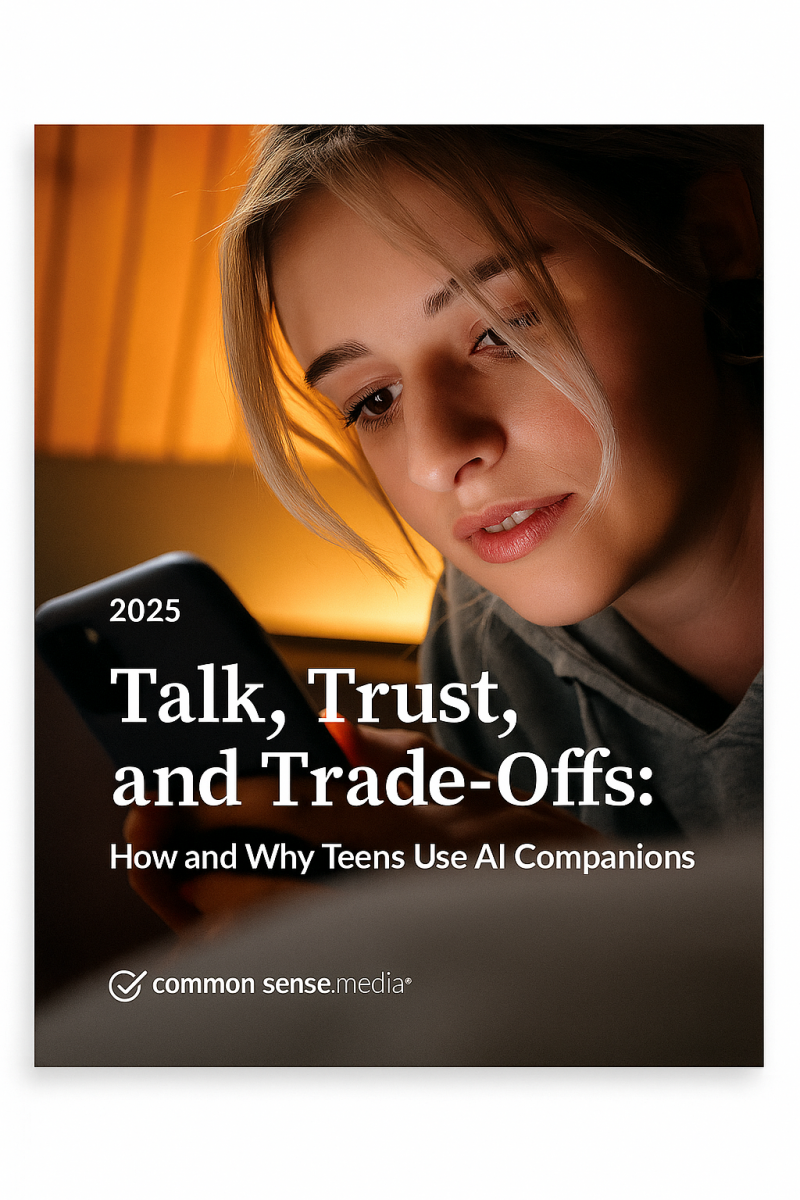 Common Sense's new report, "Talk, Trust, and Trade-Offs: How and Why Teens Use AI Companions," examines how U.S. teens aged 13 to 17 currently use AI companions. The report's findings and analysis explore usage patterns across ten key areas of growing concerns about AI companion safety, the lack of guardrails in place, and the need for evidence-based policy responses. The following is a summary of Common Sense Media's report, findings, and policy recommendations. Visit Common Sense Media's website for the full report.
What is an AI Companion?
Common Sense Media finds that the rapid rise of AI companions—on platforms like CHAI, Character.AI, Nomi, Replika, and similar conversational AI systems—has created new digital social environments. With AI companions, you can:
- Chat about your day, interests, or anything on your mind,
- Talk through feelings or get a different perspective when you're dealing with something tough,
- Create or customize a digital companion with specific traits, interests, or personalities, and
- Role-play conversations with fictional characters from your favorite shows, games, or books.
In addition to the AI companion examples above, sites like ChatGPT or Claude can also be used as AI companions, even though these tools may not have been specifically designed for this purpose.
While some of these platforms claim to be designed for users aged 18 and older, they rely on ineffective self-reporting for age assurance, which allows easy access for younger users. Other platforms, such as Character.AI, are explicitly marketed to children as young as 13 years old. These platforms––which may be presented as virtual friends, confidants, and even therapists––allow users to engage in conversations with AI entities designed to simulate humanlike interaction, and they can offer everything from casual chat to emotional support and role-playing scenarios.
As these technologies become increasingly sophisticated and accessible, parents, teachers, and policymakers must understand how and why teens interact with AI companions. Teens average eight hours and 39 minutes of screen time for entertainment daily, making AI companions a new and potentially important part of their day-to-day lives. Adolescence is a critical time for developing identity, social skills, and independence in relationship building. As AI companions become part of this stage of life, important questions arise about their impact on social development, emotional well-being, and digital literacy.
As AI companions become part of adolescence, important questions arise about their impact on social development, emotional well-being, and digital literacy.
Current research suggests that AI companions are designed to be particularly engaging through "sycophancy," which refers to a tendency to agree with users and provide validation, rather than challenging their thinking. This design feature, combined with the lack of safeguards and inadequate age verification, creates a concerning environment for adolescent users, who are still developing critical thinking skills and emotional regulation.
Common Sense Media's risk assessment of popular AI companion platforms––including Character.AI, Nomi, and Replika––found that these systems pose "unacceptable risks" for users under 18, easily producing responses ranging from sexual material and offensive stereotypes to dangerous "advice" that, if followed, could have life-threatening or deadly real-world impacts. In one case, an AI companion shared a recipe for napalm.
Key Findings: Teen Usage of AI Companions
Common Sense Media's research on AI companion usage is based on a nationally representative survey of 1,060 teens, aged 13 to 17, conducted in April and May 2025. Through this survey data and the organization's further investigations into the ecosystem of AI application use among teens, Common Sense Media identified ten key findings about teens' use of AI companions.
1. Seventy-two percent of teens have used AI companions.
Seventy-two percent of teens have used AI companions at least once, and over half (52%) qualify as regular users, interacting with these platforms at least a few times a month. Daily users make up 13 percent of all teens surveyed (8% several times daily; 5% once daily), while 21 percent use AI companions a few times per week—the most common usage pattern. More than 1 in 4 teens (28%) have never used an AI companion. Boys were slightly more likely to say they had never used an AI companion than girls (31% vs. 25%).
2. Thirty-three percent of teens use AI companions for social interaction and relationships.
Thirty-three percent of teens use AI companions for social interaction and relationships, including conversation practice, emotional support, role-playing, friendship, or romantic interactions. Nearly half (46%) of teens view AI companions primarily as tools or programs, while 33 percent indicated that they don't use AI companions or use them in ways not captured by the survey options.
3. Entertainment and curiosity drive AI companion use.
Among teens who use AI companions, 30 percent say they do so because it's entertaining, followed by those who are curious about the technology (28%). Eighteen percent use the companions for advice, 17 percent value the constant availability, and 14 percent appreciate the nonjudgmental interaction. Twelve percent of teens can share things they wouldn't tell friends or family. Boys are significantly more likely than girls to say they use AI companions because "it's entertaining" (37% vs. 24%).
4. Teen trust in AI companions is limited, and older teens are more skeptical.
Half of teens (50%) express distrust in the information or advice provided by AI companions, though trust levels vary by age. The other half of teens (50%) at least "somewhat" trust the information from AI companions, including 23 percent who trust them "quite a bit" or "completely." Younger teens (13–14) are significantly more likely than older teens (15–17) to trust advice from an AI companion (27% vs. 20%).
5. Nearly one-third of teens find AI conversations as satisfying or more satisfying than human conversations.
Thirty-one percent of teens find conversations with AI companions as satisfying or more satisfying than those with real-life friends (21% say about the same quality, and 10% say more satisfying). However, 67 percent still find AI conversations less satisfying than human conversations (47% say much less satisfying, 20% somewhat less satisfying).
6. Almost 2 in 5 AI companion users apply skills practiced with AI companions in real life.
Among AI companion users, 39 percent have transferred social skills they practiced with AI companions to real-life situations. This is significantly more common among girls (45%) than boys (34%). Starting conversations is the most commonly transferred skill (18%), followed by giving advice (14%) and expressing emotions (13%). However, 60 percent of users report that they don't use AI companions to practice social skills, which indicates limited practical application for most teens.
7. Teens overwhelmingly prioritize human friendships over AI companion interactions.
Eighty percent of AI companion users spend more time with real friends than with AI companions (68% spend much more time, 12% somewhat more time). Only six percent spend more time with AI companions with friends (1% spend much more time, 5% spend somewhat more time).
8. One-third of users experience discomfort with AI companions.
Among AI companion users, 34 percent report feeling uncomfortable with something an AI companion has said or done, though most incidents are infrequent (19% say once or twice, 9% occasionally, 6% frequently). Sixty-six percent have never felt uncomfortable.
9. One-third of users choose AI companions over humans for serious conversations.
Among AI companion users, 33 percent have chosen to discuss important or serious matters with AI companions instead of real people (17% once or twice, 12% occasionally, 4% frequently).
10. One-quarter of AI companion users share personal information.
Among AI companion users, 24 percent have shared personal or private information (such as their real name, location, or personal secrets) with AI companions (13% report once or twice, 8% occasionally, 4% frequently), while 74 percent have not.
Recommendations for a Safer Digital Future
Common Sense Media offers recommendations on AI usage and literacy initiatives for a variety of stakeholders, including tech companies that develop AI tools and parents at home.
What tech companies can do
AI companion platforms need immediate safety upgrades to protect teen users. Companies have prioritized profits over children's well-being in the past, and the same mistake cannot be made with AI companions. AI developers can:
- Implement real age assurance systems beyond self-reporting, similar to requirements for other platforms that serve minors.
- Create mandatory crisis intervention systems that immediately connect users who express suicidal thoughts or self-harm to professional help—not AI-generated responses.
- Establish clear policies with human oversight for all interactions that involve users under 18, including transparent moderation practices.
What schools and educators can do
Educational institutions have a responsibility to develop AI literacy curricula that address the specific risks of AI companions while building critical-thinking skills about artificial relationships and digital manipulation. Schools can:
- Develop age-appropriate curricula that explain how AI companions are designed to create emotional attachment, and the difference between AI validation and genuine human feedback.
- Establish clear policies regarding the use of AI companions during school hours.
- Integrate AI ethics education into existing digital literacy programs.
What parents can do
You don't need to be a tech expert to help your teen use AI companions safely. Open family conversations can make a difference in how kids approach these tools. Parents can:
- Start conversations about AI relationships by asking—without judgment—what platforms your teen uses and how they feel about AI versus human friendships.
- Recognize warning signs of unhealthy AI companion usage, including social withdrawal, declining grades, and a preference for AI companions over human interaction.
- Learn about the specific risks that teens face, including exposure to inappropriate content, privacy breaches, and potentially hazardous advice.
What policymakers can do
To set up safeguards for AI companions and ensure accountability from AI companies, policymakers can follow these specific recommendations:
- Recognize that minors cannot provide meaningful consent to perpetual and irrevocable data licenses, and prohibit such agreements for users under 18.
- Establish comprehensive safety standards and a duty of care for all AI companion platforms, including mandatory reporting of adverse incidents and concerning interaction patterns.
- Require platforms to implement robust safeguards, including age assurance, crisis intervention systems, targeted bans on usage by minors, and measures to prevent addictive engagement tactics.
The Trade-offs, and the Task Ahead
While Common Sense Media's survey data shows that most teens currently recognize differences between AI and human interactions, the widespread use of AI companions—combined with well-documented safety risks—requires continued vigilance and precautionary measures. The reality that nearly three-quarters of teens have used these platforms, with half doing so regularly, means that even a small percentage experiencing harm translates to significant numbers of vulnerable young people at risk.
Even a small percentage experiencing harm from AI companion use translates to significant numbers of vulnerable young people at risk.
Based on its findings, Common Sense Media recommends that no one under 18 use AI companions.
Until developers implement robust age assurance beyond self-attestation and platforms are systematically redesigned to eliminate relational manipulation and emotional dependency risks, the potential for serious harm outweighs any benefits.
Parents and caregivers must remain aware of these applications and maintain ongoing conversations with teens about the fundamental differences between AI interactions and genuine human relationships. Furthermore, policymakers and technology companies must collaborate to create safer alternatives that preserve the positive aspects of AI while safeguarding children.
Read Common Sense Media's full report here.
The Benton Institute for Broadband & Society is a non-profit organization dedicated to ensuring that all people in the U.S. have access to competitive, High-Performance Broadband regardless of where they live or who they are. We believe communication policy - rooted in the values of access, equity, and diversity - has the power to deliver new opportunities and strengthen communities.
© Benton Institute for Broadband & Society 2025. Redistribution of this email publication - both internally and externally - is encouraged if it includes this copyright statement.
For subscribe/unsubscribe info, please email headlinesATbentonDOTorg

Kevin Taglang
Executive Editor, Communications-related Headlines
Benton Institute
for Broadband & Society
1041 Ridge Rd, Unit 214
Wilmette, IL 60091
847-220-4531
headlines AT benton DOT org
Share this edition:


Broadband Delivers Opportunities and Strengthens Communities