

Is the FCC at Fault for Rising Connectivity Prices?

Friday, December 19, 2025
Weekly Digest
Is the FCC at Fault for Rising Connectivity Prices?
You’re reading the Benton Institute for Broadband & Society’s Weekly Digest, a recap of the biggest (or most overlooked) broadband stories of the week. The digest is delivered via e-mail each Friday.
Round-Up for the Week of December 15-19, 2025
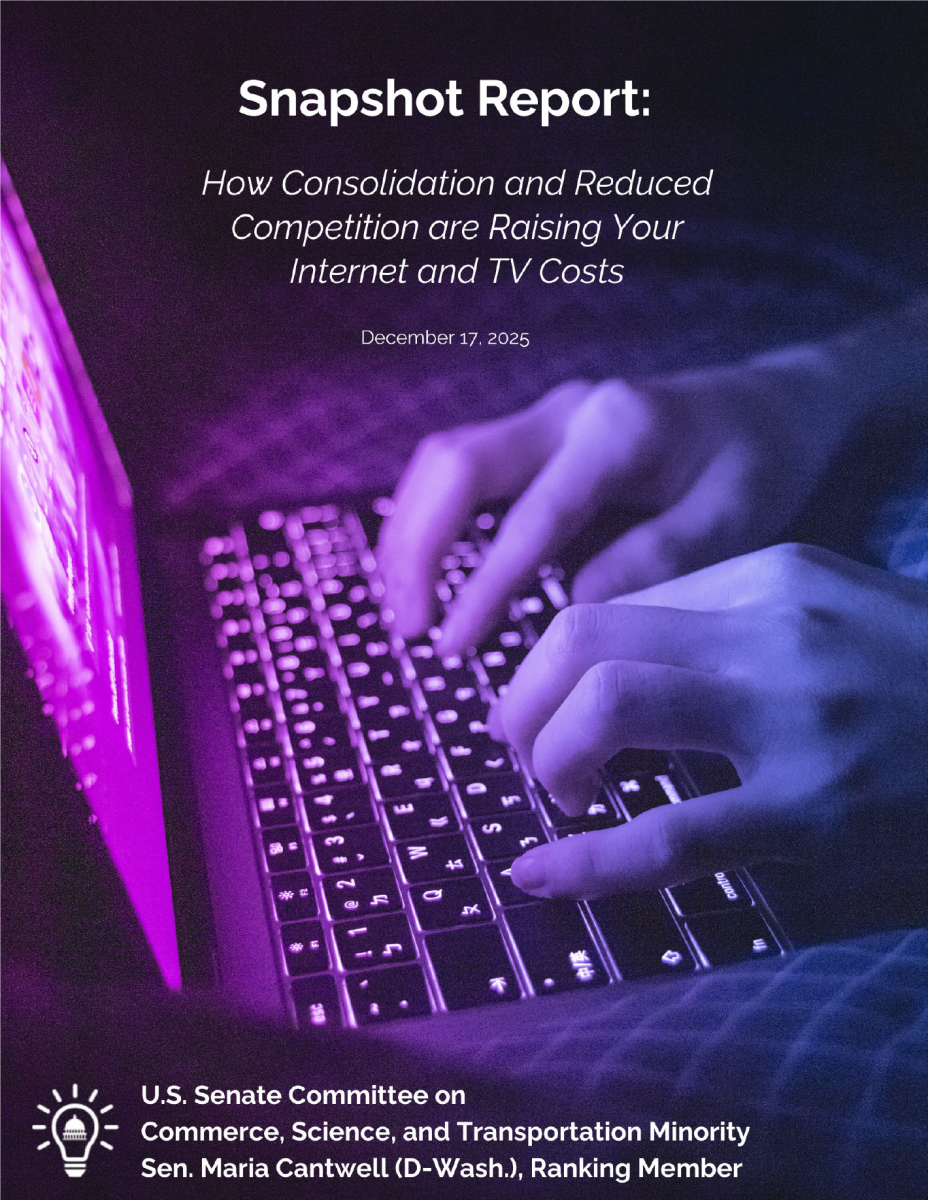 Senate Commerce Committee Ranking Member Sen Maria Cantwell (D-WA) released “How Consolidation and Reduced Competition are Raising Your Internet and TV Costs,” which examines the costs of mobile and fixed broadband internet service. According to Sen Cantwell, the report highlights "the increasing costs to American consumers of policies being pushed and actions taken" by the Federal Communications Commission (FCC) during the tenure of Chairman Brendan Carr. The report points to a growing broadband affordability crisis in the U.S.
Cellphone Service Prices are Rising, Competition is Falling
The report finds that household connectivity costs for cellphone service and broadband access continue to rise across the nation. For cellphone service in particular, U.S. residents pay some of the highest wireless costs in the world.
According to FCC data, Americans pay the second-highest wireless service prices among 26 industrialized countries. For example, on average, U.S. residents pay about 3.5 times as much for wireless service as people in Spain.
Senate Commerce Committee Democrats assert that the FCC has not done enough to support market competition and make American wireless service more affordable. As an example, the goal of helping wireless internet service provider DISH become a fourth national competitor was an integral component of the first Trump Administration’s approval of the T-Mobile and Sprint merger. In an "unprecedented move" by the FCC, Chairman Carr launched an investigation into DISH/EchoStar's spectrum use to essentially force the company to sell its spectrum, ending any chance it had of remaining a viable wireless competitor. The result: DISH/EchoStar sold most of its spectrum to AT&T and SpaceX.
With over seven million subscribers in mid-2025, Boost Mobile, DISH/EchoStar’s mobile wireless brand, was once positioned to compete head-to-head with AT&T, Verizon, and T-Mobile. Now it will lease access on other providers’ networks, a model that severely limits its ability to compete and innovate. The 5G wireless infrastructure DISH/EchoStar spent years and billions of dollars building is being decommissioned.
The fifth largest carrier, regional carrier USCellular, sold off its assets in a series of transactions waved through by the FCC earlier in 2025, despite warnings from the Department of Justice about the level of concentration in the marketplace and the dangers of the “Big 3’s oligopoly.” Experts agree that more concentrated wireless markets lead to higher prices, yet the FCC has not only failed to act but has also taken actions that solidified this oligopoly.
The major wireless carriers are increasingly relying on price increases and add-on fees rather than subscriber growth to boost revenues. Verizon has implemented monthly plan price hikes, increased fees like "administrative" charges, and pushed customers into higher-priced plans. Analysis shows that price increases alone are adding more than $1 billion in service revenue in 2025, at a time when Verizon's subscriber base is essentially flat.
Less Affordable Options for Broadband
Broadband service is becoming more expensive, less reliable, and increasingly unaffordable for consumers.
Declines in Affordability Following the End of ACP
The FCC's Affordable Connectivity Program (ACP) provided discounts of up to $30 per month for low-income households and $75 per month for households on Tribal lands, helping roughly 23 million households at its peak before funding was exhausted in 2024.
After ACP's expiration, bills for ACP households jumped by exactly the size of the voucher, often forcing families to downgrade service, cut other necessities, or disconnect altogether.
The ACP successfully brought home internet to new households. An FCC survey of ACP recipients found that nearly 50 percent reported having no home internet or relying solely on mobile internet service before receiving the ACP discount.
Despite bipartisan support in Congress for reauthorization, neither the Trump Administration nor the FCC has taken meaningful action to restart ACP. Without a broadband affordability program to offset costs for low-income households, cost pressure on providers has risen sharply since the last ACP benefit was distributed in May 2024.
Internet for Rural Americans: Higher-Cost, Less Reliable Broadband Service
Under the Trump Administration, the National Telecommunications and Information Administration (NTIA) restructured the Broadband Equity, Access, and Deployment (BEAD) Program in ways that have hurt rural households.
The NTIA's June 6 BEAD Restructuring Policy Notice did two critical things:
- Gutted "low-cost" programs. Earlier BEAD guidance offered model "low-cost" plans (e.g., $30–$40 per month) as examples for states. The revised guidance drops those benchmarks and gives providers wide latitude to define "low-cost" so long as they meet broad criteria, opening the door to $60+/month "low-cost" offerings in high-cost or low-competition areas.
- Forced states to include substantially more satellite and other non-fiber alternatives as part of their plans. New NTIA guidance encourages states to treat satellite providers as "qualified" BEAD subgrantees and to rely more heavily on fixed wireless and satellite in high-cost areas. Independent analysts have found that low-Earth-orbit (LEO) satellite offers higher prices, reduced reliability, and stricter data caps than many terrestrial options, and that treating satellite as equivalent to fiber may lock rural households into permanently higher effective costs per gigabyte. LEO satellite providers like SpaceX’s Starlink may offer “low-cost” options, but service is often capped and “deprioritized” while still being more expensive than traditional broadband providers.
For rural communities, these changes risk a future where the only "affordable" option is a high-priced satellite plan with expensive equipment that may cost hundreds of dollars and must be replaced every several years—the opposite of BEAD’s promise to bring reliable, affordable broadband to all Americans.
Hidden Fees and Broadband Consumer Labels
The FCC’s broadband label rules—a bipartisan concept mandated by the Infrastructure Investment and Jobs Act—were designed to give consumers simple, standardized labels disclosing monthly prices, all mandatory fees, typical speeds and latency, and other key service terms. These labels began appearing in 2024 to help consumers comparison-shop and see the true cost of internet service.
On October 28, 2025, the FCC voted 2-1 to propose eliminating six key consumer disclosure requirements in the broadband labels. The targeted requirements are:
- Streamlining label display and content, reading labels to consumers over the phone;
- Itemizing state and local pass-through fees;
- Eliminating the requirement that providers include ACP information in the broadband label;
- Displaying labels in customer account portals, and making them available in English and any other languages in which the provider markets its services;
- Making labels available in machine-readable format for comparison shopping; and
- Archiving labels for at least two years.
These rollbacks could make it easier for internet companies to stick consumers with hidden costs and fees. Without clear labels, consumers are less able to comparison shop, a recipe for paying more than they should.
The Impact of Consolidation
As markets consolidate across wireless, streaming, and local media, providers gain greater leverage to bundle services, add fees, and raise rates with fewer alternatives for consumers to turn to. What may begin as a modest increase in one bill can quickly cascade across a household’s entire digital budget.
If this trajectory continues, Americans will face a future with fewer choices, higher monthly costs, and reduced access to the essential connectivity required for work, education, and health care.
Congress directed the FCC to protect consumers and promote competition. However, current policies are steering the communications marketplace toward concentration and opacity rather than competition and affordability. Without a course correction, these warning signs can harden into a permanent reality where essential digital connectivity becomes more expensive, less reliable, and increasingly out of reach for millions of families.
"The American people deserve an FCC that protects them from hidden fees and promotes affordability," said Sen. Cantwell. "The FCC though, is, in my mind, doing just the opposite in allowing consolidations that reduce competition and can help drive up costs."
Sen. Cantwell asked, "What will we do to make sure consumers still have choice?"
Quick Bits
- GAO Finds Changes to BEAD Subject to Congressional Review Act
- FCC Isn’t an Independent Agency, Says Chair Brendan Carr
- Senate Letter Aims to Preserve States’ Ability to Use Broadband Infrastructure Funds as Congress Intended
- The Political Skirmish Over Trump’s AI Order Is Just the Beginning
Weekend Reads
- Washington Digital Equity Forum releases biennial report
- U.S. FWA Providers: Seasonal Slump or Victim of Their Own Success?
- AI’s Impact on American Jobs and Demands Clarity from Industry Leaders
ICYMI from Benton
- From The Great Migration to Digital Equity: Superdeterminants, Systems, and Shared Power (Part 2)
- Blue Ridge Broadband Alliance: Six Months of Progress
- Trump Executive Orders Shape Federal AI Regulation and Override State Actions
- A Progress Report on Broadband Access in Alabama
Upcoming Events
Jan 29––January 2026 Open Federal Communications Commission Meeting (Federal Communications Commission)
Feb 3-5––Net Inclusion 2026 (National Digital Inclusion Alliance)
Feb 4-5––INCOMPAS Policy Summit 2026 (INCOMPAS)
The Benton Institute for Broadband & Society is a non-profit organization dedicated to ensuring that all people in the U.S. have access to competitive, High-Performance Broadband regardless of where they live or who they are. We believe communication policy - rooted in the values of access, equity, and diversity - has the power to deliver new opportunities and strengthen communities.
© Benton Institute for Broadband & Society 2025. Redistribution of this email publication - both internally and externally - is encouraged if it includes this copyright statement.
For subscribe/unsubscribe info, please email headlinesATbentonDOTorg

Kevin Taglang
Executive Editor, Communications-related Headlines
Benton Institute
for Broadband & Society
1041 Ridge Rd, Unit 214
Wilmette, IL 60091
847-220-4531
headlines AT benton DOT org
Share this edition:


Broadband Delivers Opportunities and Strengthens Communities