

The End of Progress: New Data Raises the Alarm that No Progress May Be the New Normal for the Digital Divide

Tuesday, November 25, 2025
Digital Beat
The End of Progress:
New Data Raises the Alarm that No Progress May Be the New Normal for the Digital Divide

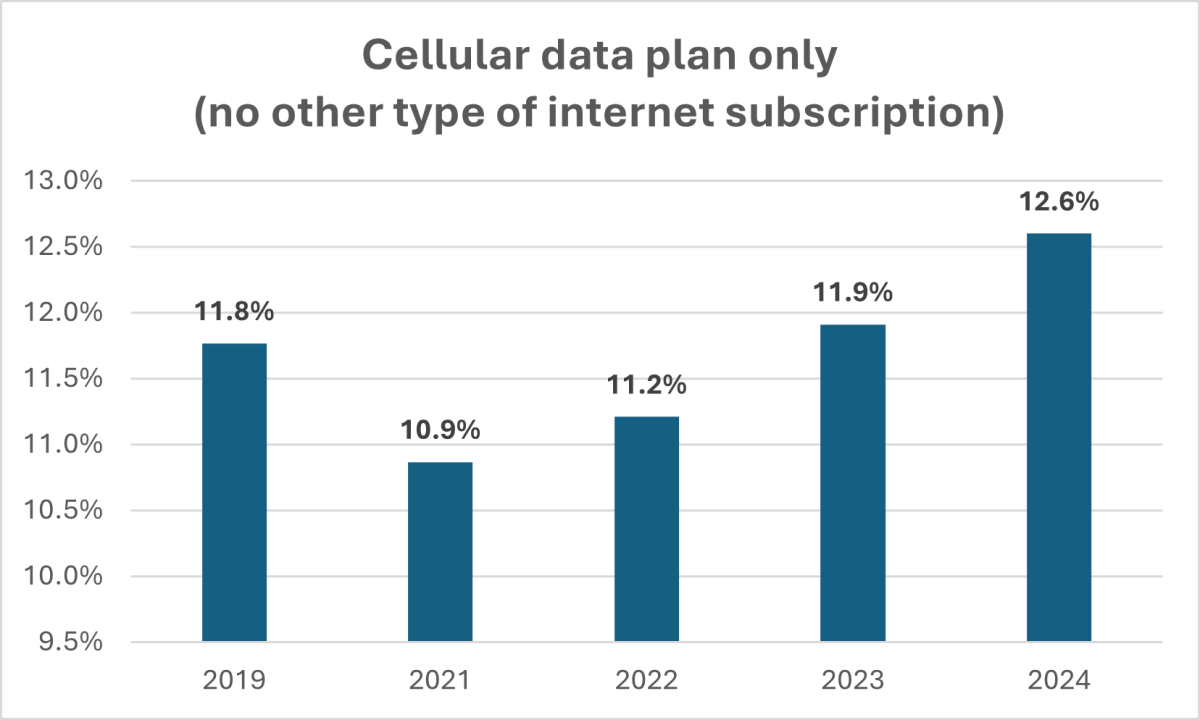
The 2024 American Community Survey (ACS) shows essentially no change in wireline broadband adoption between 2023 and 2024 and just a 1-point increase in the share of households with broadband of any type. The primary growth in broadband adoption of any type occurred among households with subscriptions to cellular data plans for smartphones. The figure below shows the data.

These are not large year-to-year changes, which is the important point. As noted in Marking Progress, Targeting Gaps: Lessons From Broadband Adoption Trends, growth in broadband adoption has been tepid in recent years.1 For wireline broadband adoption, the 0.2 percent increase from 2023 to 2024 continues the pattern of slow growth that began after 2021. The last significant growth in overall broadband adoption occurred between 2019 and 2021: a 4.7 percentage point increase in wireline adoption and a 3.7 increase in adoption of broadband of any type.2

While wired broadband adoption stagnated, more households relied on cell phones only for at-home internet access in 2024 than 2023—a phenomenon most common among low-income households. In 2023 ACS data, 22 percent of households with incomes below $25,000 annually relied only on cell plans for home internet service compared with just 8 percent for households making more than $250,000 per year.3 Further, assuming a decline in “cell only” represents progress (i.e., because more people have multiple access means), then the figure below shows that progress from 2019 to 2021 was erased by 2023, with further deterioration in 2024.
A Persistent Digital Underclass
The stagnation in wireline broadband adoption, coupled with the uptick in cell-only households, signals that, for lower-income Americans, “no progress” could be the “new normal” for the digital divide. As Marking Progress found, just more than half of low-income Americans (54%) had both wireline and cellular data subscriptions in 2023, while 87 percent of households in the upper quarter of the income distribution had both types of subscriptions.4 The 2023 figures were essentially unchanged compared to 2021, when 53 percent of low-income households had both tools and 88 percent of upper-income Americans did. The 2024 ACS data strongly suggest that those figures—and the associated gap—did not change.
The implication is that an income constrained saturation pattern is hardening. Since 2021—and confirmed by 2024 ACS data—the United States has reached a point in which the vast majority of well-off Americans have both wireline and wireless subscriptions, while a significant minority have only one of those tools. Income is sufficient for low-income households to subscribe to one of the tools but not to both. That is evident in data from 2023 on broadband subscription of any type (i.e., either wireline or wireless service) which shows that 82 percent of Americans with annual incomes under $25,000 have broadband of any type and 90 percent of those between $25,000 and $50,000 in annual income have broadband of any type.
The consequences of this income constrained saturation point becoming an enduring condition are important. Key services in our society are increasingly optimized in a way that assumes people have both mobile and fixed-access subscriptions. Think about healthcare services. They are increasingly designed such that online tools contain test results, post-intervention care instructions, and wellness information as well as a platform for telehealth sessions. A fixed (i.e., wireline) connection at home (with a sufficiently large video display) facilitates video interactions with healthcare providers. For check-ins, co-pays, and reminders, many systems are designed with mobile access at the forefront. Educational or job training applications function best with large displays on fixed connections, while mobile access supplements with scheduling and other resources. With generous (or unlimited) monthly data allotments, fixed subscription plans give users latitude to benefit from such applications that mobile plans alone do not allow.
The Digital Future Needs Help
The 2024 ACS data strongly suggest that stasis has become the norm for broadband adoption—particularly for wireline service. But contemporary events raise the real risk of backsliding for low-income households. Prior analysis shows that up to 5.6 million low-income households may lose broadband connectivity as One Big Beautiful Bill provisions take full effect in the coming years.5
Additionally, the emergence of a “two speed” economy further confirms that the income constrained adoption pattern for broadband may be here to stay. Wage gains for low-income households—which were robust in recent years—have stalled this year, as wage growth for the upper third of earners has grown 3.6 percent compared with only 0.9 percent for those in the lower third.6 Similarly, median income grew by 4.2 percent for higher income groups in 2024 ACS data while they were unchanged for middle- and lower-income households.7 None of the available data suggests that households that struggle to afford broadband will gain the purchasing power to subscribe to service.
This leaves policy intervention as an option to reverse the tide. The return of a program such as the Affordable Connectivity Program (ACP) is an obvious tool, as it proved effective in bringing millions of households online and maintaining connections for millions more low-income homes.8 The chances of ACP’s revival do not seem good at the moment. But it is worth noting that all the current promises of the digital revolution—productivity enhanced by artificial intelligence, improvements in health care delivery and outcomes—are premised on widespread and robust connectivity among all citizens. The current data on broadband adoption indicate that this connectivity will not likely happen due to market forces alone.
John B. Horrigan, PhD, is a Benton Senior Fellow. He is a national expert on technology adoption, digital inclusion, and evaluating the outcomes and impacts of benefits designed to promote communications technology adoption and use. Horrigan served at the Federal Communications Commission as a member of the leadership team for the development of the National Broadband Plan. Additionally, as an Associate Director for Research at the Pew Research Center, he focused on libraries and their impact on communities, as well as technology adoption patterns and open government data.
Notes
- John B. Horrigan, “Making Progress, Targeting Gaps: Lessons from Broadband Adoption Trends,” Benton Institute in Broadband & Society. June 2025. Available online at: https://www.benton.org/publications/broadband-adoption-trends
- There was no ACS 1-year data for 2020 due to difficulties in collecting data during the pandemic.
- John B. Horrigan, “Marking Progress, Targeting Gaps,” Benton Institute for Broadband & Society, June 2025. See Table 14. Available online at: https://www.benton.org/sites/default/files/MarkingProgress.pdf
- The income threshold for lower-income Americans is households whose annual incomes is $25,000 or less; the threshold for upper-income Americans is households earning $150,000 annually or more.
- John B. Horrigan,” Broadband Adoption and the Fraying Social Safety Net,” ,” Benton Institute for Broadband & Society. July 2025. Available online at: https://www.benton.org/blog/broadband-adoption-and-fraying-social-safety-net
- Jeanne Whalen, “The Two-Speed Economy Is Back as Low-Income Americans Give Up Gains.” The Wall Street Journal, September 16, 2025. Available online at: https://www.wsj.com/economy/us-economy-analysis-wealthy-low-income-8ba80ccc?mod=hp_lead_pos4
- Paul Overberg and Konrad Putzier, “Inflation Erased U.S. Income Gains Last Year.” The Wall Street Journal, September 9, 2025. Available online at: https://www.wsj.com/economy/consumers/census-income-insurance-poverty-2024-31d82ad0?mod=article_inline
- John B. Horrigan, “One More Thing: The ACP Boosted Rural Adoption and Helped Keep the Subscription Vulnerable Online,” Benton Institute for Broadband & Society. April 2025. Available online at: https://www.benton.org/publications/one-more-thing
The Benton Institute for Broadband & Society is a non-profit organization dedicated to ensuring that all people in the U.S. have access to competitive, High-Performance Broadband regardless of where they live or who they are. We believe communication policy - rooted in the values of access, equity, and diversity - has the power to deliver new opportunities and strengthen communities.
© Benton Institute for Broadband & Society 2025. Redistribution of this email publication - both internally and externally - is encouraged if it includes this copyright statement.
For subscribe/unsubscribe info, please email headlinesATbentonDOTorg

Kevin Taglang
Executive Editor, Communications-related Headlines
Benton Institute
for Broadband & Society
1041 Ridge Rd, Unit 214
Wilmette, IL 60091
847-220-4531
headlines AT benton DOT org
Share this edition:


Broadband Delivers Opportunities and Strengthens Communities